
Applicable Models:
2003 - 2007 Ford F-250, F-350, F-450, F-550 Super Duty
2003 - 2005 Ford Excursion
2004 - 2010 Ford Econoline E-350, E-450
2003 - 2008 Ford F-650, F-750 medium duty
Applicable Engine(s):
6.0L Power Stroke V-8 diesel
Test Gauge Adapter:
Test Procedures
For any 6.0 liter Power Stroke engine fuel pressure is tested at the secondary fuel filter housing. After removing the small plug next to the fuel pressure regulator cover, an adapter is installed that accepts a fuel pressure test gauge. Despite being physically close to the fuel pressure regulator, this passage is connected to the outlet circuit that carries fuel to the left and right cylinder heads. The fuel pressure measured here is therefore the actual pressure as delivered to each cylinder head.
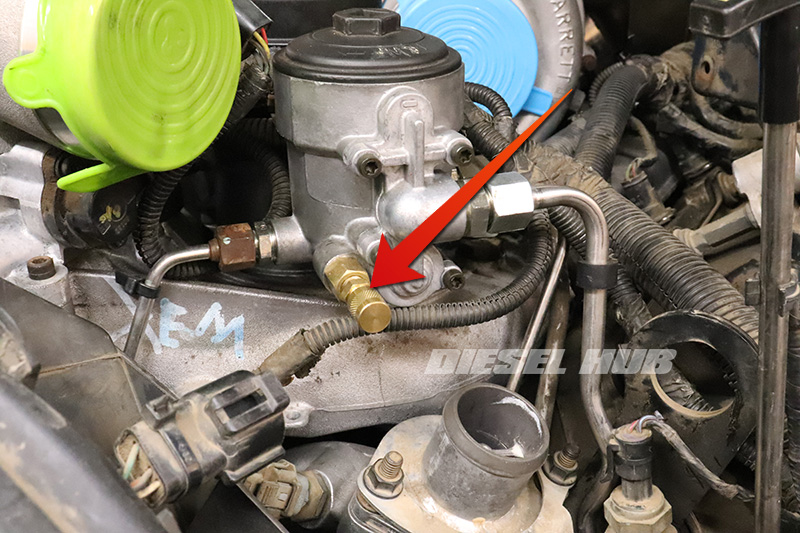
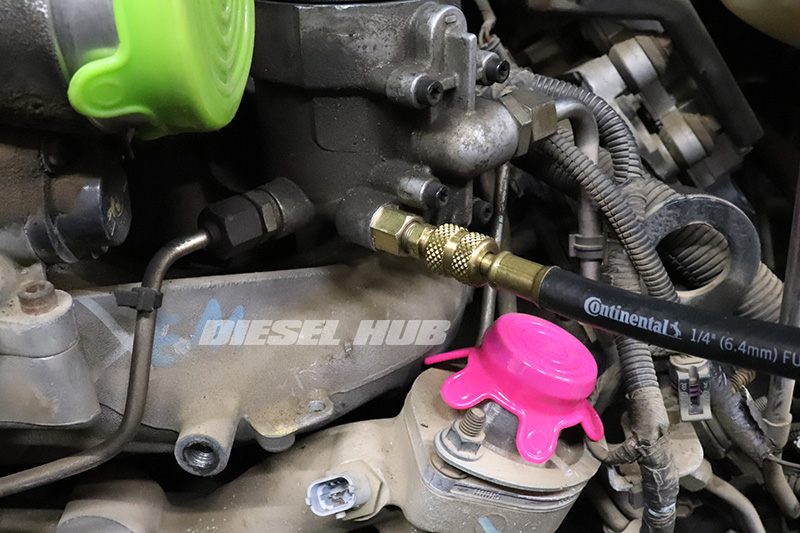
The preassembled adapter seen in figures 1 and 2 (DP-161501) allows test equipment with a 1/4 inch flare fitting to connect directly to it - this is a very common thread type and size for fuel test gauges. It can get tight reaching beneath the cold-side intercooler tube and maneuvering around the upper radiator hose. I suggest disconnecting the large connector for the fan clutch and pushing it aside for easier access. The test adapter shown can be permanently installed to the housing or removed as desired.
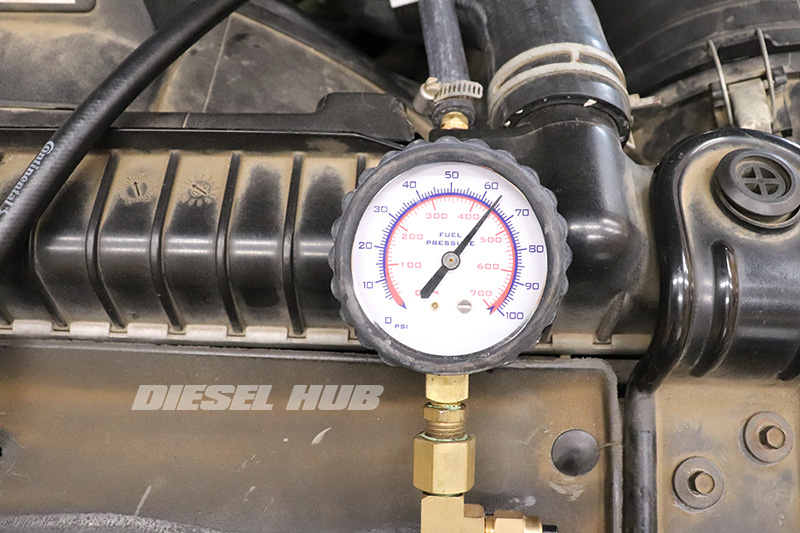
Fuel pressure should be checked key on, engine off (KOEO) first. Cycling the key to the "run" position initiates the glow plug preheat sequence and runs the fuel pump for approximately 20 seconds. This gives adequate time to walk from the driver's entry to the engine compartment to read the pressure gauge. Fuel pressure should exceed 45 psi at all times and under all conditions. In my experience, the typical range on a healthy system should be 55 to 65 psi.
After verifying that an engine has good fuel pressure KOEO, the test should be repeated key on, engine running (KOER). It is critical to ensure that the test equipment is clear of the engine and will not become entangled in any of its moving parts while the engine is running. Once again fuel pressure should measure above 45 psi, but 55 to 65 psi is more ideal.
Although some variation is normal and to be expected, fuel pressure should remain relatively stable and the electric fuel pump should provide consistent flow. If the needle bounces around more than a few psi or bounces around erratically, there is likely an issue within the system.
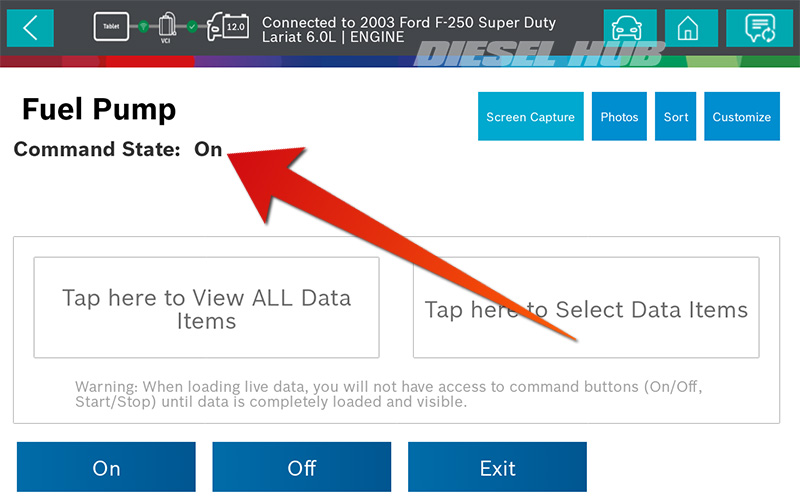
If the fuel system is to be bled and fuel pressure checked at the same time, it may be convenient to control the fuel pump state with a scantool. By accessing the fuel pump test, the pump can be commanded to the "on" and "off" states with the click of a button. This test is shown on the Bosch ADS diagnostic tool in figure 4 below.
I encourage this method when repairs have left the fuel system full of air. It is much more efficient to run the fuel pump continuously than switch the key "on" and "off" repeatedly to cycle the fuel pump every 20 seconds. Furthermore, using the scantool feature does not cycle the glow plugs unnecessarily and thus battery life will be preserved.
Sources of Low Fuel Pressure
Low fuel pressure could be caused by a number of conditions, including:
- One or more plugged fuel filters
- Failing/faulty fuel pump
- Collapsed pressure regulator spring
- Pressure regulator poppet stuck open, damaged, or installed incorrectly
Diagnosing a low pressure condition and zero pressure condition are two very different concerns. If, for example, power to the fuel pump can be verified but the fuel pump is not running, it is the obvious culprit. To avoid making costly assumptions, you'll need to evaluate the details pertinent to your situation. Ask yourself these questions:
- Did the low fuel pressure condition come after a specific repair was completed?
- Has the fuel system been serviced regularly? Recently?
- Is the fuel pump making strange sounds? Is it running at a continuous rhythm?
- How old is the regulator spring/poppet?
- Is there or has there been a fuel contamination issue?
Drawing a conclusion as to the cause of low fuel pressure can be significantly more time consuming than testing the pressure. Understanding the fundamentals of how this fuel system works can make the diagnostic process less cumbersome.
Fuel System Overview
The 6.0 liter Power Stroke utilizes a dual filtration system. The primary fuel filter is located in the fuel conditioning module while the secondary filter housing is mounted atop the engine adjacent to the oil filter housing. Fuel is drawn into the fuel conditioning module and through the first stage of filtration via an electric fuel pump that is contained within; water separation also occurs in the conditioning module and water settles to the bottom of the housing where it can be drained off.
After water separation and the first stage of filtration, pressurized fuel (typically 55 to 65 psi) is pumped to the secondary fuel filter. After the second stage of filtration, excess fuel is returned to the tank by means of a spring loaded poppet valve that regulates fuel pressure.
Filtered fuel is delivered to each cylinder head in what is referred to as a "dead-end" strategy wherein there is no return to the tank between the fuel injectors and the secondary filter housing. Once fuel enters the delivery lines to each cylinder head, there is no return pathway to the filter housing nor the fuel tank. When a test fitting is installed at the secondary filter housing, it measures fuel pressure as delivered to each cylinder head gallery, i.e. the fuel at this point has already completed the second stage of filtration.


Editor, Diesel Hub