A flywheel is found attached to the crankshaft of engines in vehicles that are equipped with a manual transmission. It serves as part of the coupler between the engine and transmission, stores kinetic energy to improve clutch engagement behavior, and incorporates a large diameter ring gear that is driven by the starter motor to start the engine. Automatic transmissions use an alternative component called a flexplate. A flexplate is typically lighter, but ultimately serves a similar purpose. There are two types of flywheels - single mass and dual mass.
Single Mass Flywheel
A single mass flywheel (SMF) is a flywheel in its simplest and most basic form. Single mass flywheels are machined from a solid piece of cast or billet material with no moving parts. The starter gear ring can be integral to the flywheel or can be a separate, welded component. When the clutch pedal is released to engage the clutch, the clutch disc makes contact with the face of the flywheel under tremendous force from the pressure plate. It is the frictional force between the clutch disc and flywheel surfaces that ultimately provides vehicle motion.
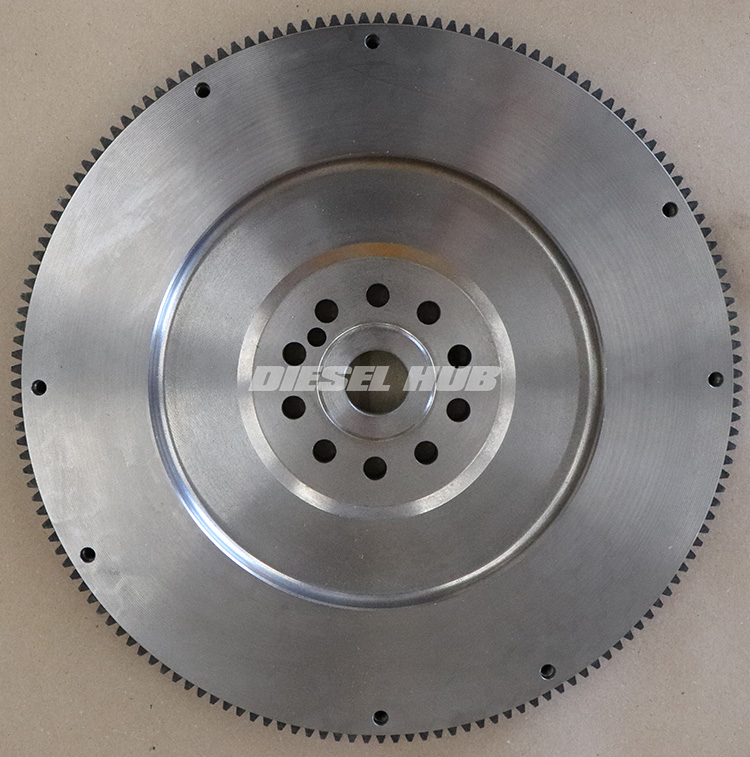
Single mass flywheels are known to transmit certain vibrations and resonance through the transmission geartrain because there is no dampening mechanism. Therefore, some transmissions have a tendency to produce gear rollover noise.
Advantages
- Highly reliable, simple component
- Low replacement cost
- In many instances they are resurfaceable, resulting in reduced repair costs
Disadvantages
- No dampening of engine vibrations and resonance; some powertrain configurations particularly susceptible to gear rollover noise
Dual Mass Flywheel
A dual mass flywheel (DMF) is a special type of flywheel designed to dampen vibrations created by engine pulses and prevent them from traveling through the transmission geartrain. Certain vibrations and resonance can cause the presence of gear rollover noise, a phenomena in which the geartrain quite literally rattles while a manual transmission is in neutral and the clutch is engaged with the engine. Gear rollover noise has the propensity to produce loud and even unpleasant noises echoing from within the transmission case.
Certain transmissions are more prone to gear rollover noise than others. The case material and the number of gears in mesh both play a role in the amount of noise a manual transmission produces. Transmissions with a cast iron case are typically less noisy because the heavier, denser material is better suited to absorb sound and vibrations than the lightweight aluminum cases used in most modern transmissions.
The goal of a dual mass flywheel is to dampen the source of the sound before it is transmitted to the transmission. This is accomplished by creating two separate components (masses) that pivot independently, but this movement is restricted to only a few degrees. Figure 2 below identifies one half of a dual mass flywheel; specifically, the dampening side of the flywheel.
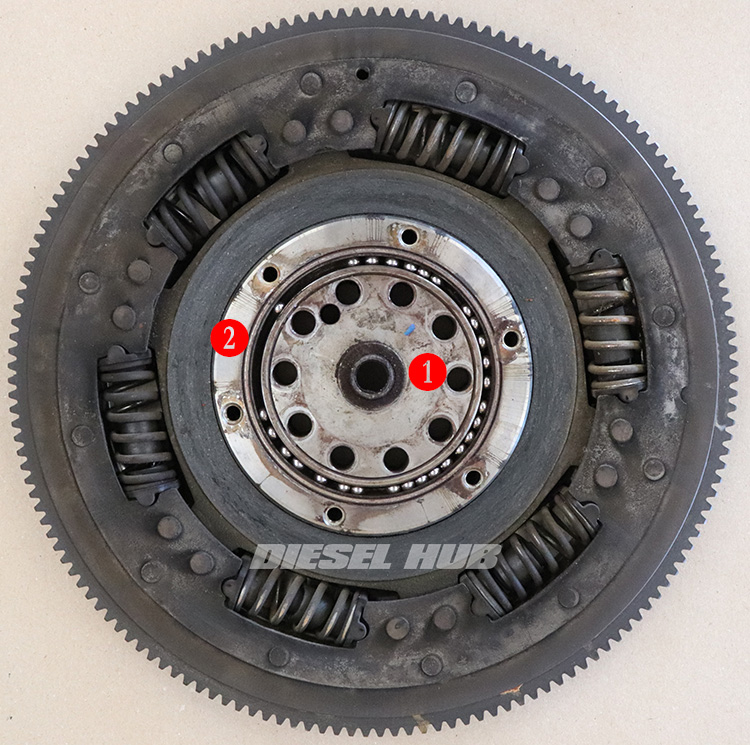
The small flange (labeled 1) is bolted to the engine and transmits power to the first mass while the larger diameter flange (labeled 2) is bolted to the second mass of the flywheel, which makes contact with the clutch disc and transmits power to the transmission. The second mass (not pictured) largely resembles a single mass flywheel - it is the engine side of the flywheel (pictured) that is responsible for dampening vibrations.
Rotational energy from the engine must travel against one side of the set of springs in the outer area of the flywheel. The armature on the opposite side of the spring transmits this energy to the outer flange (labeled 2), which is secured to the second mass. The ball bearings located between labels (1) and (2) facilitate limited, but independent movement between the two masses. Dampening is accomplished because power from the engine must pass through the series of springs.
One could create a strong and convincing argument that the dual mass flywheel serves one purpose - to reduce warranty claims and complaints related to transmission noise. Surely, dealerships and transmission repair shops prefer to limit callbacks of any kind and it can be difficult to relay to customers what is considered normal transmission noise.
Advantages
- Dampening of engine pulses and associated vibrations
- Lower transmission noise
Disadvantages
- Complex mechanical structure yields more opportunity for failure
- Less reliable than a single mass flywheel
- High replacement cost
Rigid & Dampened Clutch Disks
The clutch disk, sometimes also referred to as the friction disc, is the portion of the clutch assembly that becomes sandwiched between the flywheel and pressure plate. Its hub is splined to the transmission input shaft, which is how torque is transmitted to the transmission from the engine. Clutch disks come in rigid and dampened varieties.
A rigid clutch disk is a simple component with a layer of friction material embedded around the circumference on both faces. A metal structure connects the frictional part of the disk to the centrally located hub, which is splined to fit over the transmission input shaft. It is simple and basic in a similar manner that a SMF is.
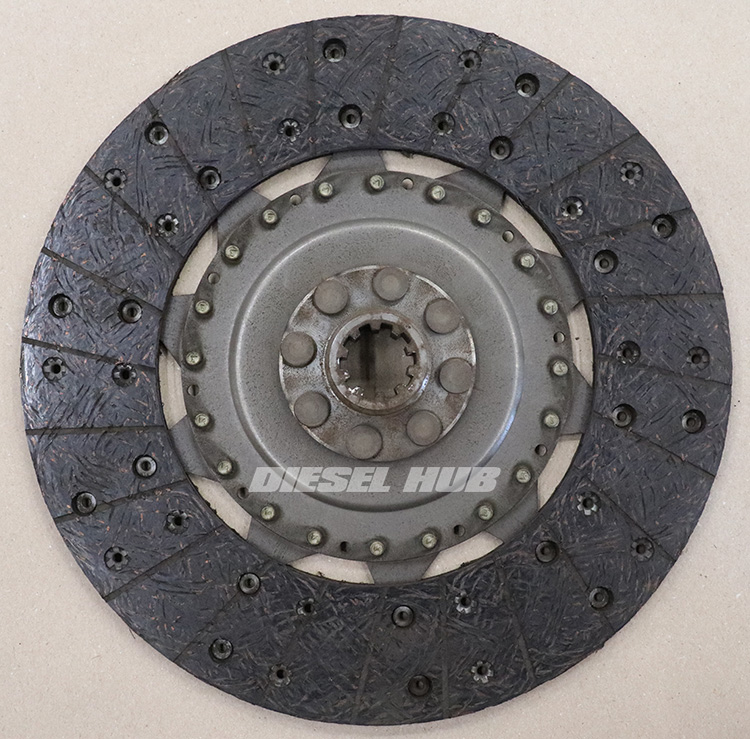
A dampened clutch disk utilizes a series of springs to isolate the outer ring, where the friction material is embedded, and the inner hub, where torque is transfered to the transmission input shaft. This spring system serves a similar function as that employed in a DMF, but the operation is different because there is nowhere near the same freedom of rotation between the two segments on a dampened clutch disk. While the dampening mechanism can mitigate some vibration, its primary role is to absorb shock loads that could damage the clutch disk or transmission components.

Rigid clutch disks are lighter and therefore limit the inertial forces at the input shaft of the transmission. This can positively effect shift quality because transmission synchronizers must slow or speed up the input shaft to complete a gear engagement. However, rigid clutch disks generally provide a rougher initial engagement, are prone to chatter, and provide no protection against shock loads during up and down shifts.
Dampened clutch disks absorb shock loads and provide a more streamlined progression while shifting gears. Additionally, mitigating some of these harsh forces can reduce NVH and protect the transmission from premature wear or even damage. Although they do have more moving parts, they're not commonly associated with failures like a DMF.
There is no fundamental rule dictating that a DMF must be used with a dampened clutch disk or that a SMF must be used with a rigid one. Both types of clutch disks are compatible with each type of flywheel and you'll find manufacturers offering clutch kits in various combinations. Historically, it has not been uncommon for original equipment manufacturers to issue a rigid clutch disk for certain applications and a dampened one for others, sometimes using GVWR as the qualifier for each type.
Single Mass Flywheel Conversions
Single mass flywheel conversions are widely popular as a result of the lower cost and improved reliability. Keeping in mind that there is always a trade-off when deviating from the OEM configuration, a SMF is the obvious choice for maximum reliability and the DMF will provide the lowest NVH. For anyone on the fence about converting to a SMF because of the additional noise, you are likely to be happier with the factory DMF setup.