
Applicable Models:
2014 - 2023 Ram 1500
2014 - 2019 Jeep Grand Cherokee
2021 - 2023 Jeep Wrangler
2021 - 2023 Jeep Gladiator
Applicable Engine(s):
3.0L EcoDiesel V-6
The 3.0 liter EcoDiesel is found in 2014 to 2023 Ram 1500s, 2014 to 2019 Jeep Grand Cherokees, and 2021 to 2023 Jeep Wranglers and Gladiators. It is largely praised for its balance between power and fuel economy, with many owners enjoying 30+ miles per gallon on the highway. The engine was ultimately retired and did not return for the 2024 model year as electrification and small, power-dense gasoline engines took focus.
All EcoDiesel vehicles are equipped with an automatic oil change indicator system. This system perpetually monitors driving conditions and alerts the operator with an "Oil Change Required" message when the vehicle is in need of an oil change. However, under no circumstances should any oil change interval exceed 10,000 miles of driving or a 12 month period. If a biodiesel blend in excess of B5 (>5% biodiesel) is being used, this interval is shortened to a maximum 8,000 miles or 6 months. The oil change indicator will not compensate for biodiesel usage.
There are no sensors that measure oil quality or remaining oil life. When "Oil Change Required" is displayed, it is nothing more than the result of a calculation. The ECM arrives at this conclusion by monitoring and comparing driving conditions - idle time, acceleration rates, and engine loads, for example. Frequent idling and/or towing will result in a shorter oil change interval than long periods of driving at highway speeds with no cargo.
Oil Analysis
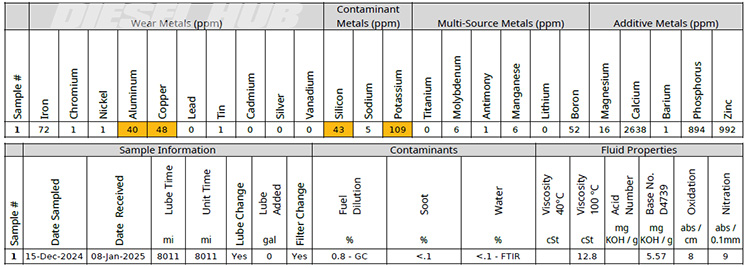
A routine oil analysis is an excellent method for monitoring engine condition and substantiating oil change intervals. As previously mentioned, the oil change monitoring strategy has no physical or unique sensor with the ability to measure oil quality. It cannot determine actual oil viscosity, fuel dilution, soot infiltration, and wear metal levels; it relies on nothing more than an algorithm that determines when an oil change is required based on how rigorously the engine has been driven.
An oil analysis monitors all these factors and is in effect the only absolute method for determining oil quality and whether or not that oil remains suitable for use. I highly recommend the Oil Analyzers test service by Amsoil. This service will test the oil viscosity, fuel dilution percentage, and identify excessive soot and wear metals in the oil.
While the factory oil change indicator is convenient, it makes many unfavorable assumptions. The most constructive method for validating oil change intervals is by actively monitoring the condition of the oil. Sampling at each oil change helps understand how practical the oil change indicator guidance is, whether more frequent service is required, and it can identify potential engine problems before they become more significant. As an engine ages, more frequent sampling may be advisable in order to perpetually monitor oil change intervals and make adjustments, i.e. changing engine oil more often, as is deemed necessary.
Oil Capacities & Requirements
The engine oil capacity of an EcoDiesel engine depends on the model year and application; the table below identifies the oil capacity for each application.
| Year & Model | Oil Capacity [1] |
|---|---|
| 2014 - 2019 Ram 1500 | 10.5 quarts |
| 2020 - 2023 Ram 1500 | 8.5 quarts |
| 2014 - 2019 Jeep Grand Cherokee | 8.0 quarts |
| 2021 - 2023 Jeep Wrangler/Gladiator | 9.0 quarts |
[1] - With oil filter replacement.
All EcoDiesel engines require a 5W-40 synthetic motor oil. FCA retroactively modified the original 5W-30 oil specification for all Ram 1500 and Jeep Grand Cherokee models equipped with the 3.0 liter EcoDiesel built before June 30th, 2016 in TSB 18-078-16. The TSB directed dealers to drain/replace the engine oil and affix a new "5W-40" sticker to the oil fill cap. For 2014 to 2016 model year vehicles with an original owners manual, the 5W-30 specification is null and void.
There is much speculation as to why the viscosity was changed, but 5W-30 obviously proved inferior to the new 5W-40 standard. It wouldn't be much of a stretch to assume that, at least under certain conditions, the 5W-30 viscosity was found to be insufficient. Whether or not this was directly corroborated with a string of engine component failures remains up for debate. 5W-30 engine oil is less viscous than 5W-40, meaning that it is thinner. Automakers often adopt low viscosity motor oils as part of a strategy to improve fuel economy - thinner oil pumps easier and contribute to lower windage losses.
For 2014 to 2019 model year engines, a 5W-40 full synthetic motor oil meeting API CJ-4 specifications is required. For the 2020 to 2023 model year engines, the engine oil must meet API SN and FCA material specification MS-12991 criteria.
Engine Oil Recommendations

Diesel Hub recommends the following Amsoil products for all vehicles equipped with the 3.0 liter EcoDiesel:
Amsoil Signature Series Max Duty 5W-40
For 2014 - 2019 model years, meets API CJ-4 specifications
Amsoil 5W-40 FS Euro Spec
For 2020+ model years, meets API SN and FCA MS-12991 specifications
Amsoil synthetic engine oils offer:
- Superior resilience against thermal, mechanical, and chemical breakdown of the engine oil
- Superior protection against fuel dilution and soot infiltration
- Excellent oil flow and engine protection in sub-zero temperatures and during cold starts
Amsoil is a leading manufacturer of synthetic oils and lubricants, including a line of engine oils engineered to meet the demands specific to turbocharged diesel engines with modern emissions and exhaust aftertreatment systems.
Oil Filters & Related Parts
| Component | Applications | Part Number(s) | Remarks |
|---|---|---|---|
| Engine oil filter | 2014 - 2019, all | MOPAR 6822 9402 AA | [2] |
| 2020 - 2023 Ram, 2021 - 2023 Jeep | MOPAR 6850 7598 AA | [2],[3] | |
| Oil filter housing cap | 2014 - 2018 Ram, 2014 - 2019 Jeep | MOPAR 6814 8345 AA | [4] |
| Oil pan drain plug | 2014 - 2018 Ram, 2014 - 2019 Jeep | MOPAR 6821 1183 AA | [5] |
| 2019 - 2023 Ram, 2021 - 2023 Jeep | MOPAR 0651 3414 AA | ||
| Oil fill cap | 2014 - 2019 Ram | MOPAR 6822 9365 AA | --- |
| 2014 - 2019 Jeep | MOPAR 6814 7542 AA | ||
| 2020 - 2023, all | MOPAR 6839 9323 AA |
[2] - Includes new gasket for oil filter housing cap
[3] - Includes oil filter housing cap
[4] - Old style cap; newer style oil filter includes cap, not available separately
[5] - Can be reused if seal is in good condition, inspect and replace as necessary
How to Change the Engine Oil in a 3.0 EcoDiesel
Click any thumbnail to view fullsize, detailed image

- With the vehicle parked on a level surface, locate and loosen the oil fill cap.

- Place a suitable collection pan or container beneath the oil pan. It must have a minimum capacity slightly larger than the engine oil capacity for the particular vehicle (between 8 and 10.5 quarts, depending on the application).
- Remove the drain plug with a 13 mm socket or box-end wrench.
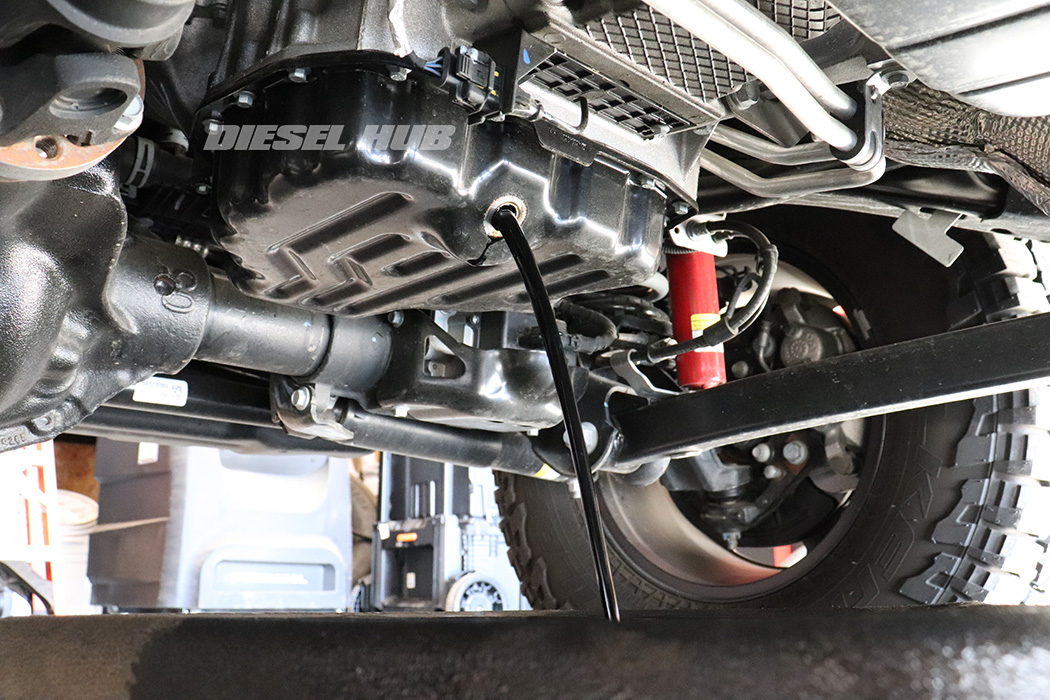
- Allow the oil to drain completely. Later style oil pans drain from the rear of the pan at an angle, so position the drain pan accordingly to prevent spills.

- Early style Ram 1500 oil pan, for reference. Note that the drain plug is mounted vertically on this type of pan.

- Locate the oil filter housing on the driver side of the engine. It is a cartridge-type filter with a black plastic cap.
- Loosen the the oil filter housing cap completely with a 1-1/16 inch or 27 mm socket.
- Allow the oil to drain from the filter housing for 3 to 5 minutes before removing the cap and filter from the housing.

- The later engines found in the Jeep Gladiator and Wrangler have a busier engine compartment and the oil filter housing cap is more difficult to reach due to the location of the ABS pump and routing of the air intake tube. A long extension is useful in reaching the cap.

- Remove the cap and oil filter.
- On early style engines, remove the cap, then extract the filter from the housing.
- On later engines, the oil filter will be attached to the cap and they are removed as an assembly.
- Take care not to drop any debris or contaminants into the oil filter housing.
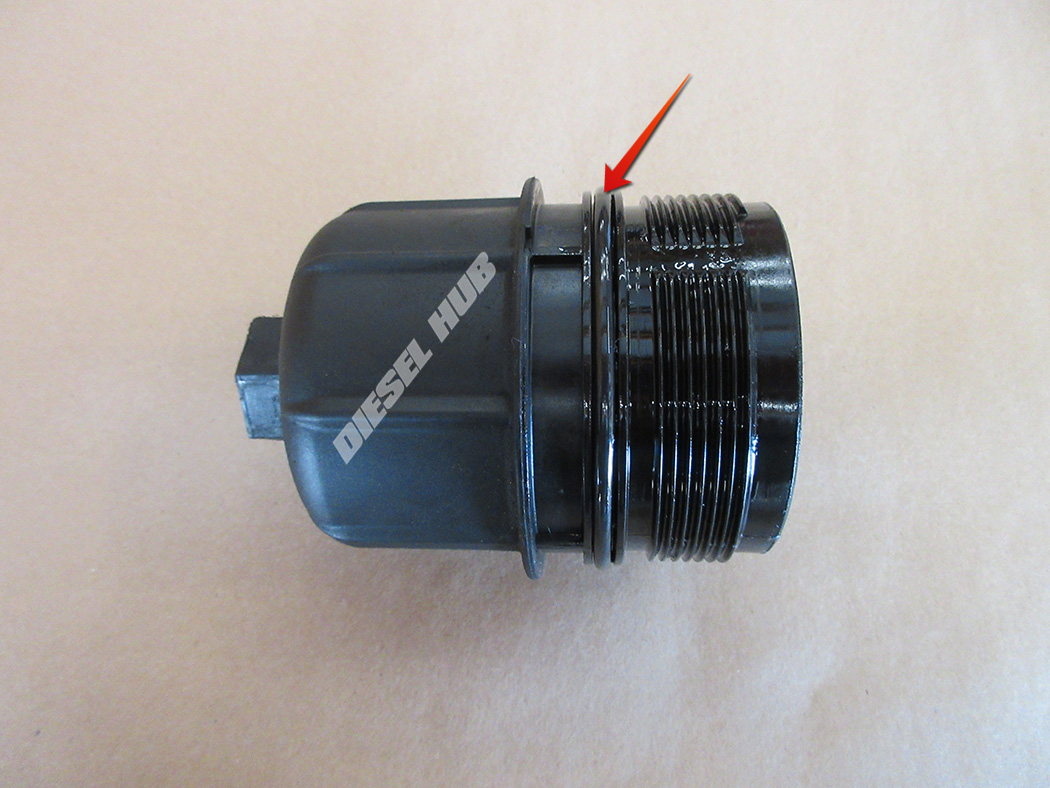
- On early engines, remove and replace the large o-ring seal on the cap. Coat the new o-ring in clean motor oil before installing.
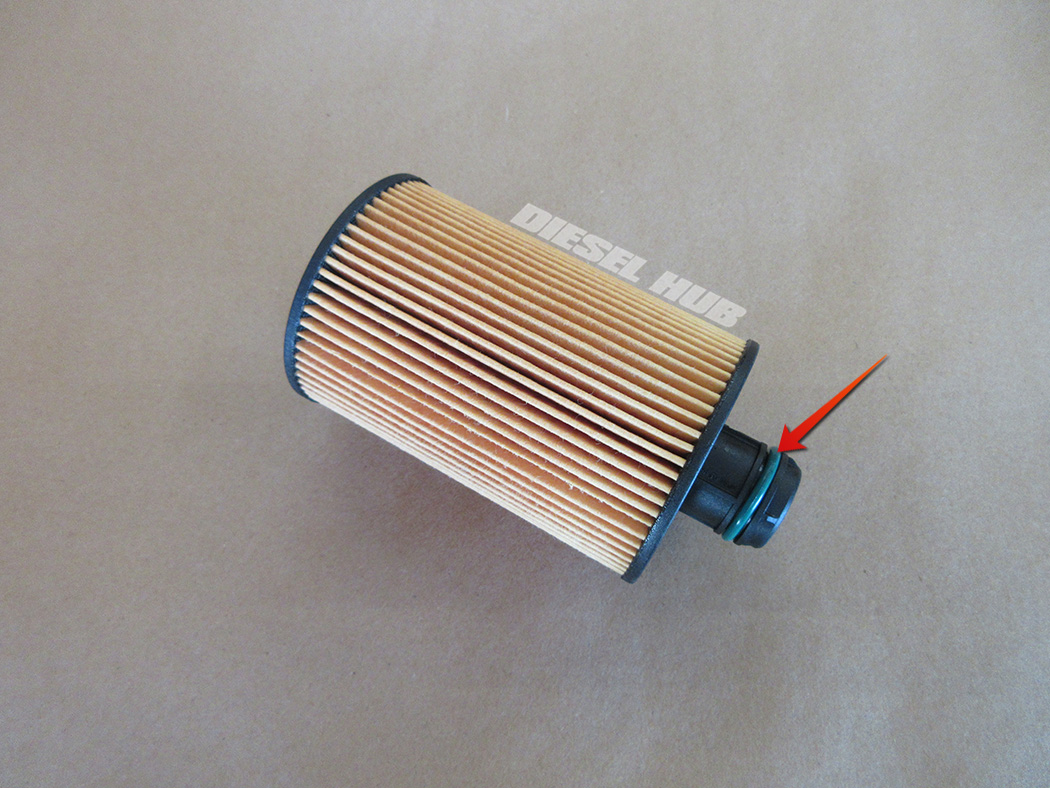
- Coat the o-ring at the tip of the filter element with clean motor oil.
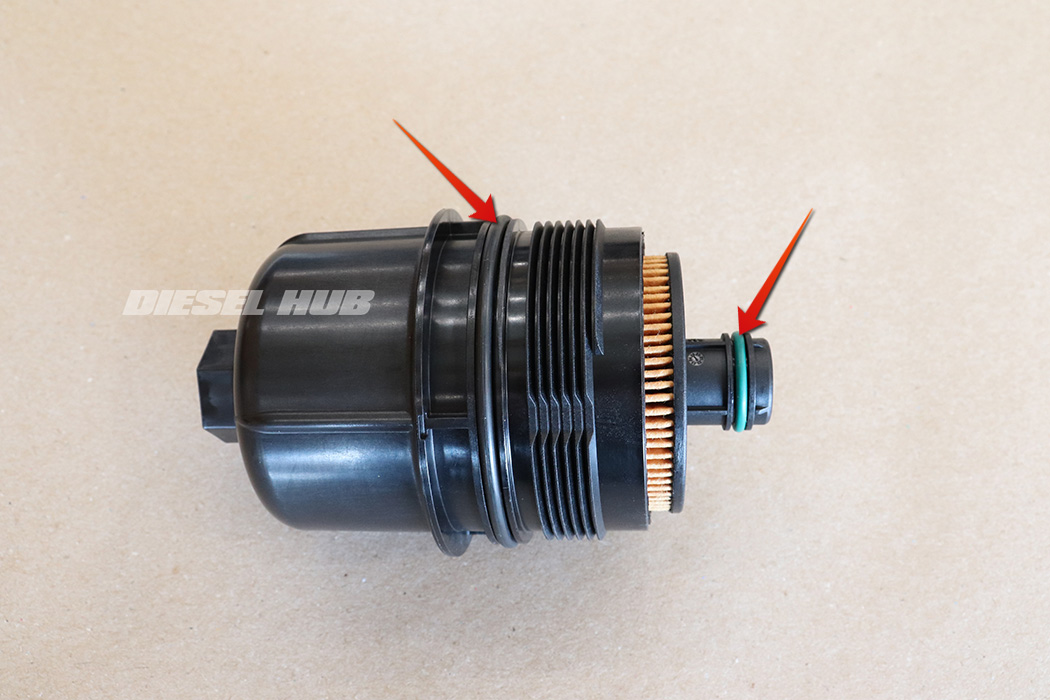
- On later engines where the cap and filter element are an assembly, liberally coat the large o-ring on the cap and the small o-ring at the tip of the filter with clean motor oil.
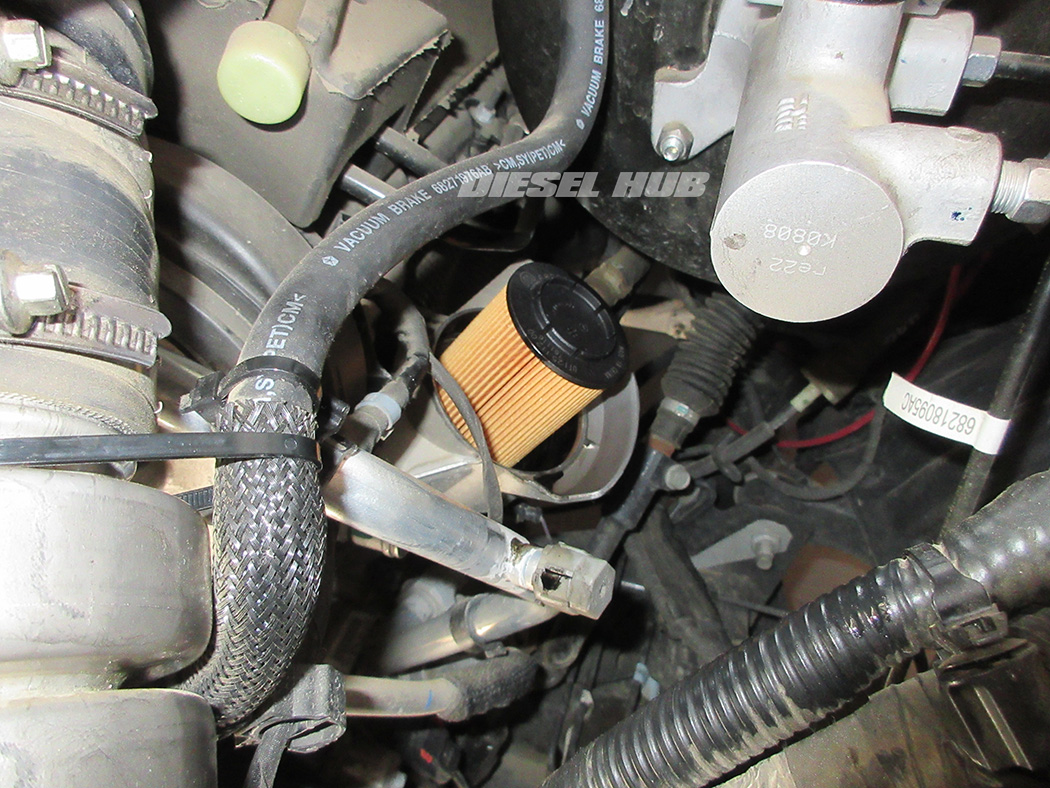
- Install the new oil filter in reverse order.

- Install the oil filter housing cap.
- Torque the cap to 18 ft-lbs (25 N-m, 216 in-lbs).
- Do not overtighten the cap as it is plastic and will crack.
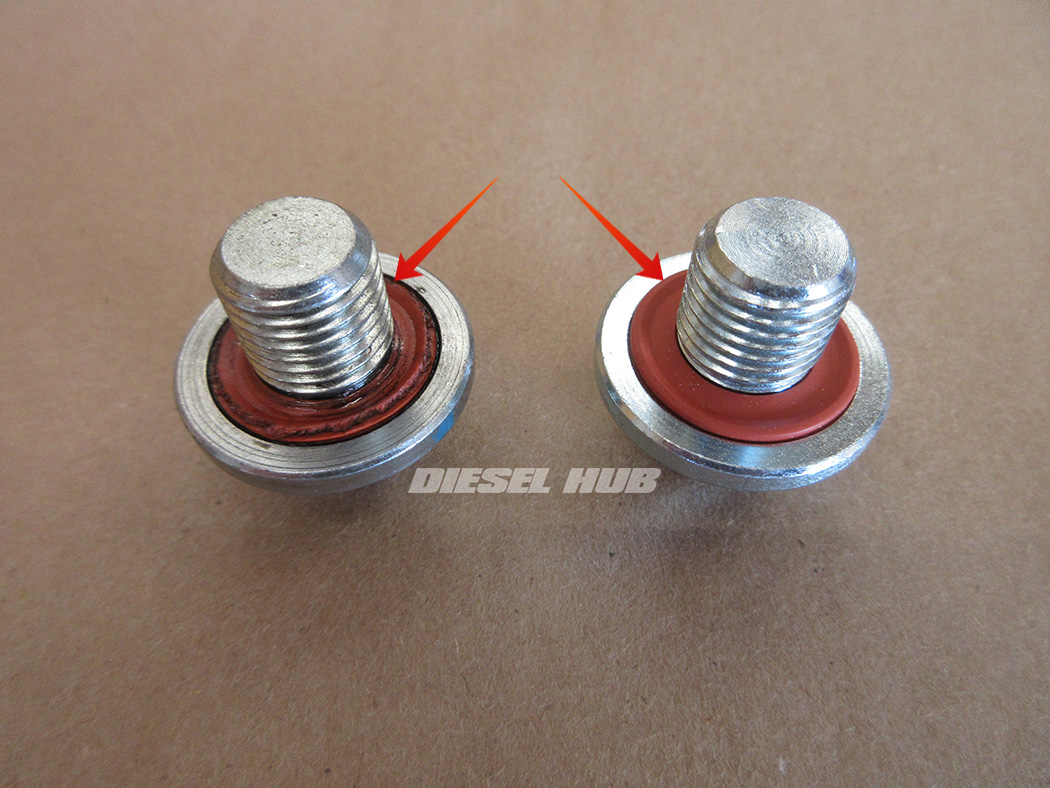
- Inspect the drain plug to determine whether or not it can be reused (early style drain plug shown, later style has a large black gasket).
- Note the significant wear and tearing on the old drain plug pictured (left).
- Coat the drain plug gasket with clean motor oil.

- Install the drain plug, then snug down with a wrench.
- The factory torque spec is 33 ft-lbs but this is widely challenged because of the gasket type. A crush washer, for example, would require more torque to obtain a positive seal, but the EcoDiesel drain plugs use a formed rubber gasket. The drain plug will seal as long as it is snugged down and excessive torque is not necessary.
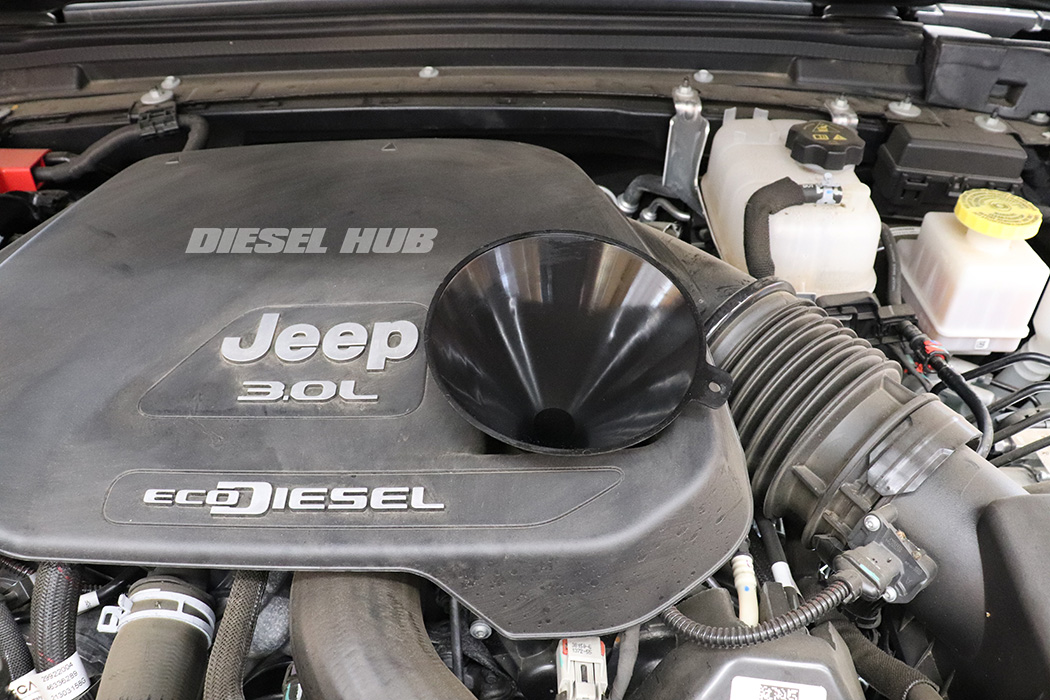
- Refill the engine with new motor oil based on the capacity of your application.
- 10.5 quarts for 2014 to 2019 Ram 1500 models.
- 8.0 quarts for 2014 to 2019 Jeep Grand Cherokees.
- 8.5 quarts for the 2020 to 2023 Ram 1500.
- 9.0 quarts for the 2021 to 2023 Jeep Gladiator and Wrangler.
- Reinstall the fill cap.
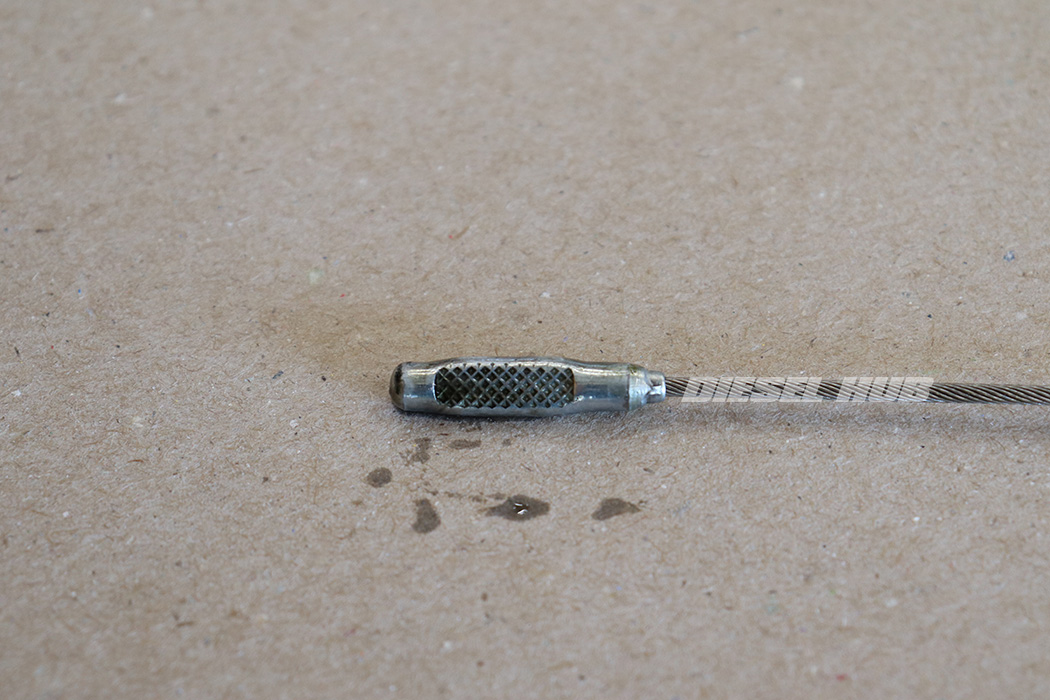
- Verify correct engine oil level using the dipstick. It is normal for the level to appear slightly higher than normal because the filter housing has been drained.
- Check for leaks before and after starting the vehicle.
- Recheck engine oil level after the first drive.