Applicable Models:
2003 - 2010 Dodge Ram 2500, 3500, 4500, 5500
2011 - 2012 Ram Trucks Ram 2500, 3500, 4500, 5500
1999 - 2010 Ford F-250, F-350, F-450, F-550 Super Duty
1999 - 2005 Ford Excursion
Applicable Transfer Cases:
New Venture NV-273 (NV-273, NV-273F, NV-273D, NP-273, etc)
New Venture NV-271 (NV-271, NV-271F, NV-271D, NP-271, etc)
Fluid Capacity:
2.0 quarts (4.0 pints)
Fluid Spec:
MOPAR ATF +4 (Dodge/Ram applications)
MERCON LV ATF (Ford applications)
The New Venture model NV-273 and NV-271 transfer cases are found in the 1999 to 2010 Ford Super Duty and 2003 to 2012 Ram 2500 to 5500 models. It is a chain driven transfer case with a multi-piece cast aluminum case. The NV-273 is shifted electronically while the NV-271 is shifted manually; the two transfer cases are otherwise very similar, internally and externally.
Some versions may also use the now-defunct "New Process" or "NP" nomenclature. Depending on its application, it can also go by the designation NP/NV 271-F ("Ford") or NP/NV 273-D ("Dodge"). These transfer cases can quickly be identified by the model listed on the silver and red ID tag mounted to the rear of the case.
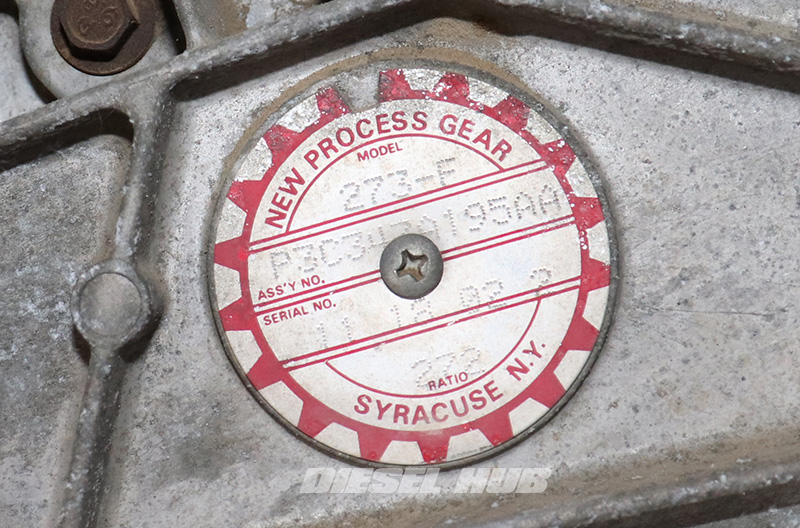
Service Information
For Dodge trucks, transfer case service is specified at 60,000 mile intervals or 48 months under normal drive conditions and 30,000 mile, 24 month intervals under "severe" service conditions. Ford specifies transfer case service at 150,000 mile intervals under normal conditions and 60,000 mile intervals under "severe" service conditions.
Severe conditions include frequent or heavy use of the four wheel drive system and other circumstances where the transfer case is subjected to rigorous conditions. When in doubt, owners should choose to adhere to the more stringent maintenance guidelines. The fluid should be changed as soon as possible anytime that the transfer case is submerged because water infiltration is probable; even a small amount of water in the case will compromise lubrication.
Fluid Specifications
MOPAR ATF+4 is specified for Dodge applications while Ford's superseded specification is MERCON LV ATF. The original Ford spec was MERCON ATF, but this has long been defunct. An in-depth history of Ford's ATF supersessions is available here: Ford transfer case fluid history. There is nothing inherently different between the Ford and Dodge transfer case variants that would prevent ATF+4 from being used in a Ford case and MERCON LV from being used in a Dodge case.
Aftermarket automatic transmission fluids are also acceptable so long as they meet ATF+4/MERCON LV specifications and are safe to use as a transfer case lubricant. Some ATFs, including Ford's MERCON V, cannot be used in transfer cases. I've found Amsoil's Signature Series FE transmission fluid to be an excellent alternative to either OEM fluid.
Service Procedures
While these transfer cases have a 2 quart capacity, you'll need to have a 3rd quart on hand to account for fluid that cannot be pumped from the bottom of the bottom and that which remains in the hose/pump mechanism after the bottle is depleted; it's quite difficult to pump every last drop from a quart size bottle, and depending on the length of the hose used you'll have at least some waste.
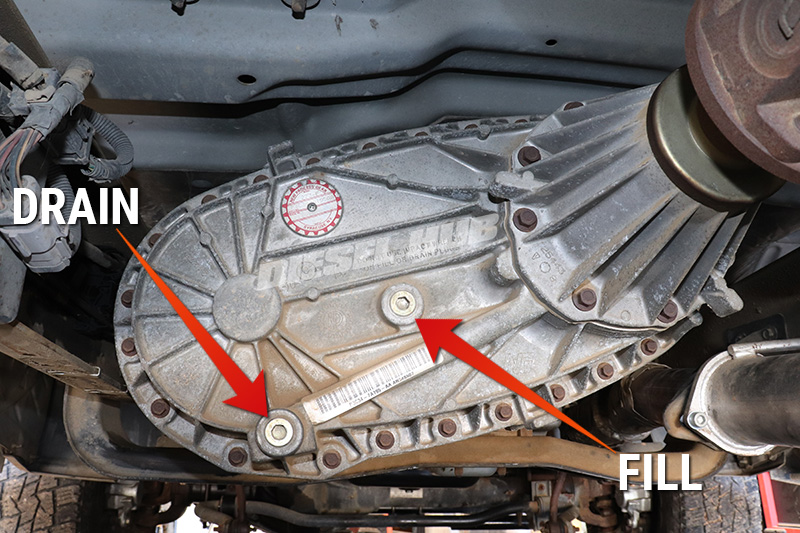
Begin by locating the drain and fill plugs at the rear of the case. Intuitively, the drain plug is the one that is located at the low point on the transfer case housing. Place a suitable pan beneath the transfer case to collect the oil as it drains. Remove the fill plug first. This will result in a smooth, consistent stream from the drain plug when it is removed.
If only the drain plug is removed air cannot easily displace the fluid as it drains and it will "glug" from the drain opening with an unpredictable nature. Also note that the stream will not flow straight down because the drain opening is horizontal; position the drain pan accordingly. The drain and fill plug on this transfer case required a 10 mm hex bit (Allen).
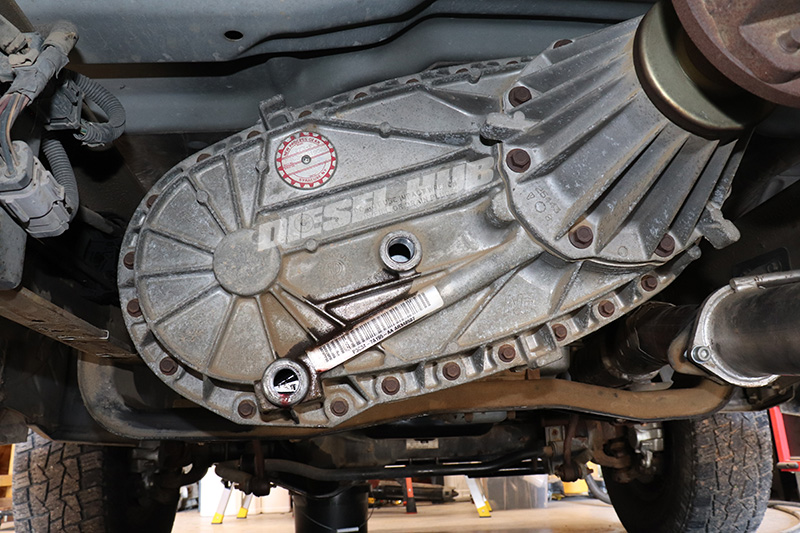
As the fluid drains and the length of the stream decays, adjust the position of the drain pan as necessary. If you wish to capture a sample of the fluid for inspection (recommended), do so as soon as the drain plug is pulled since any particles should have settled to the bottom of the case. Transfer cases do not normally run dirty, thus an excessive amount of metal particles in the oil should be treated as abnormal. Any large metallic chips would indicate damage above-and-beyond normal wear.
Once the draining fluid is reduced to a drip, thoroughly clean the drain and fill plug. Note that they are interchangeable and there is no difference in the threads, length, etc.
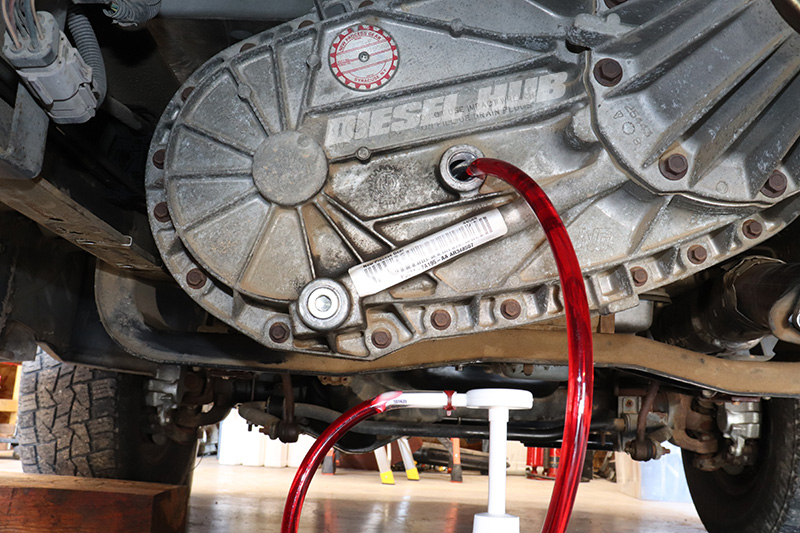
Replace the drain plug and torque to 20 lb-ft. The drain/fill plugs have tapered threads and are to be installed dry. Once the drain plug has been reinstalled, begin adding fluid through the fill plug opening. Oil pumps that attach direct to the top of a quart bottle are a convenient way to add fluid (figure 4). The correct fluid level is achieved when it reaches the lower level of the fill plug opening. Continue to add fluid until it begins to drip/run out of the fill plug opening.
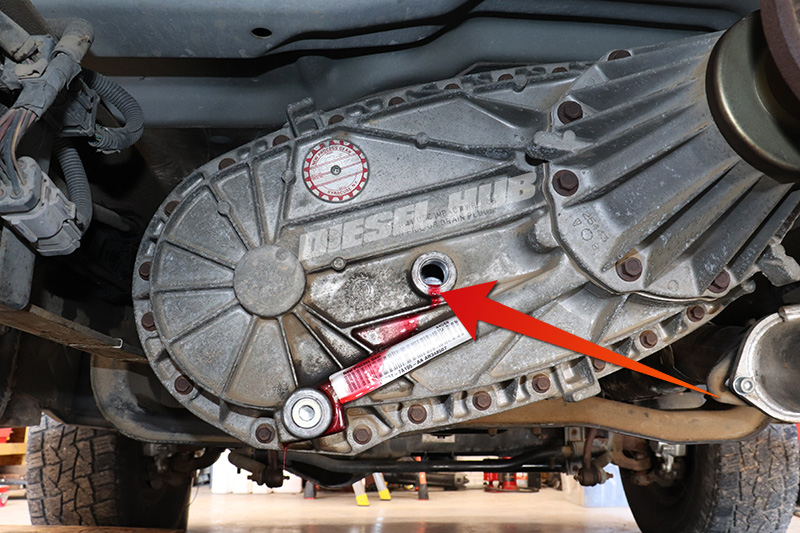
Once fluid begins to dribble from the fill plug opening, reinstall the fill plug and torque to 20 lb-ft. Clean up any oil spills so that leaks can easily be detected in the future. The next time the vehicle is driven, I recommend engaging four wheel drive to exercise the system and confirm proper operation with no irregular noise.