Motor oil is the lifeblood of any internal combustion engine. Engine oil lubricates the contact surfaces between components in various mechanical systems, reducing friction and minimizing wear in a highly demanding environment. Without it continuously circulating through an engine, we wouldn't get too far.
Diesel engine oils are a special breed because these lubricants have to contend with soot infiltration and are susceptible to fuel dilution at much higher rates than other types of engines. These engines are also expected to work hard, requiring greater consideration to anti-wear agents that can resist extreme pressure and function at high temperatures.
Engine oil is formulated using a base oil and a series of additives. While there are commonalities in the additive packages found in most oils, the blending ratios and additive combinations used can be proprietary to a specific producer and/or product line. Some formulations may use a higher concentration of anti-wear agents while others will be heavier on detergents and dispersants. It is for this reason that producers can develop products for specific markets and uses, i.e. "high mileage" engine oils.
Classifications & Specifications
In the most basic of terms, engine oils are classified, marketed, and sold by their viscosity grade or "weight". However, there are additional considerations that apply to modern engines, including the oil's API category and type. Furthermore, manufacturer specific requirements have become increasingly common to address higher operating temperatures and other special considerations that OE's have had to address.
Viscosity Grade
In the United States, lubricant producers generally follow Society of Automotive Engineers (SAE) standards. Oils that follow the SAE viscosity grade scale are labeled "SAE" followed by the SAE viscosity grade (i.e. SAE 10W-30). Viscosity grades are a reference to the oils viscosity at cold temperature, high temperature, or in the case of multi-grade engine oils, both.
Single grade or "straight weight" engine oils are labeled with a single viscosity grade - SAE 30 or SAE 30W, for example. When the letter "W" is present the oil is being labeled based on its Winter or low temperature viscosity. When the letter "W" is absent, the oil is being labeled based on its high temperature viscosity. The "W" in oil viscosity grades is often misinterpreted as referring to "weight" when it in fact it is short for "Winter".
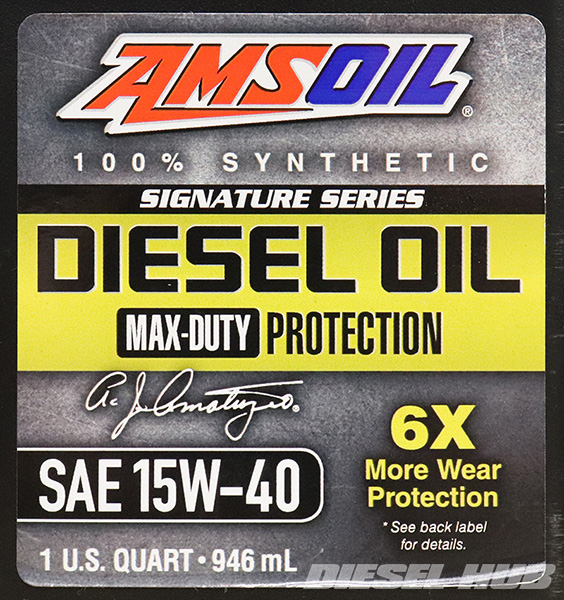
All multi-grade engine oils are labeled with both a Winter and high temperature viscosity. A 15W-40 engine weight, for example, falls in to the 15 weight category at -13 °F (-25 °C) and the 40 weight category at 212 °F (100 °C). The viscosity grades outlined by the SAE correspond with a minimum and maximum kinematic viscosity for that grade. The SAE specification also outlines acceptable test methods and producers must adhere to the standard in its entirety in order to label a product with an SAE viscosity grade.-13 °F is chosen to emulate a Winter environment where oil becomes more viscous and is therefore more resistant to flow. 212 °F is chosen as the high temperature viscosity because it closely emulates the flow performance of the oil at or near its intended operating temperature.
It is important to distinguish that the standards set forth for engine oils do not apply to gear oils. For example, SAE 40 engine oils fall into the SAE 90 gear oil grade in terms of actual viscosity. The numbers themselves are arbitrary and not a direct reference to a specific viscosity, thus they cannot necessarily be applied across different standards.
API Category
The American Petroleum Institute (API) develops and publishes standards regarding various aspects of petroleum distillates and products. Whereas the SAE standards set specifications for the viscosity range of engine lubricants, API standards specify minimum performance characteristics, most often with a focus on emissions related considerations. Examples of these performance characteristics include oxidation resistance, particulate and deposit limits, and catalyst compatibility (i.e. low ash requirements in applications employing a diesel particulate filter).
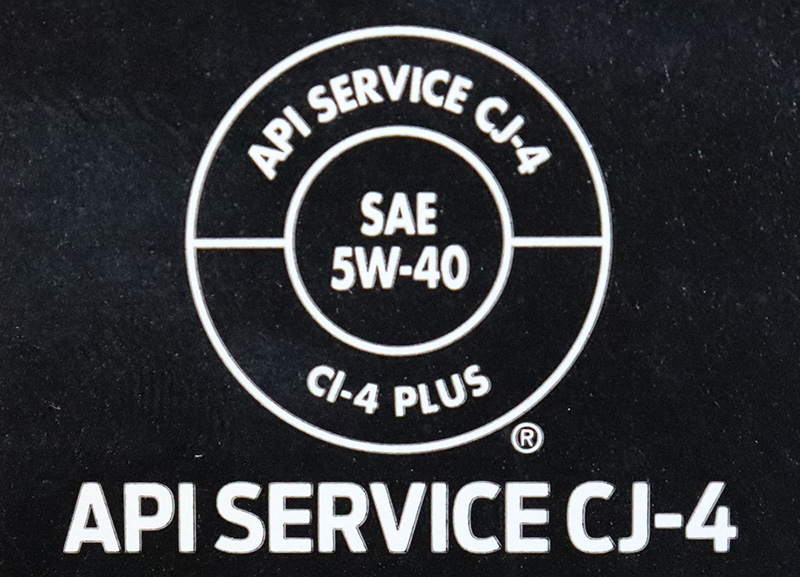
The API category of an engine oil has become increasingly more important, specifically in modern diesel engines with exhaust aftertreatment systems. With very few exceptions, API categories are backward compatible and but not forward compatible. If an engine or vehicle manufacturer specifies an API engine category for a specific engine, this requirement should not be ignored. Active API categories for diesel engine oils include FA-4 and CK-4.
Types
Motor oil is available in conventional, semi-synthetic (synthetic blend), and full synthetic varieties. The type of motor oil is a direct reflection of the base oil that it is formulated from and how it is processed. The American Petroleum Institute recognizes five groups of base oils, identified as group I through V.
Group I, II, and III base oils are refined from crude oil. Group I and II oils are the least refined, least expensive, and least desirable from a performance perspective. Although they are adequate in less demanding environments, they are not well suited for the high heat, high stress demands in internal combustion engines. Group III base oils are more heavily refined and processed, resulting in the formation of purer and more uniform hydrocarbon structures.
Conventional motor oils produced from group III base oils provide favorable performance characteristics but are more expensive than those produced from group I and II base oils. Group III base oils can also be used in the production of semi-synthetic and even full synthetic lubricants, but the later requirements significant processing.
Group IV base oils are made from polyalphaolefins (PAOs), which are synthetic hydrocarbons. This is the most common base oil used in the production of full synthetic lubricants. Creating this base oil requires extensive processing in which hydrocarbons are, for lack of a better word, assembled in the desired molecular structure. The benefits of this process are that the resulting hydrocarbons are of uniform structure and the base oil is very pure with minimal contaminants and no volatile hydrocarbons, which have a higher propensity to vaporize into gas.
Group V base oils consist of any chemically engineered oil that does not fall into categories I through VI. Silicon, esters, and polyglycols are amongst the base oils that fall under the group V umbrella. It can also include vegetable oils and other organic products. These are often mixed with other base stocks to enhance performance characteristics and create desired properties for the lubricant.
An engine oil can be formulated from any combination of these base oils and does not have to be derived from any single group. There is no debating against the superiority of synthetic motor oils. While more expensive to produce, they are significantly more resilient and resistant to breakdown when subjected to high temperatures, pressures, and stresses. It is for this reason that more-and-more equipment manufacturers are specifying full synthetic engine oils, especially where turbochargers are employed and oil change intervals are relatively long.
Manufacturer Specific Requirements
General Motors, Ram, and Ford Motor Company all have examples of special requirements for the oil used in at least some of their engines. GM created the Dexos D (previously Dexos 2) specification with the introduction of the 3.0L Duramax and requires that the engine oil used in these engines be approved under their parameters. The primary purpose of the GM-specific performance criteria is to prevent vehicle owners from using an engine oil that they deem subpar. Many major motor oil producers - Mobil 1, Valvoline, Royal Purple, Castrol - have products that are certified by GM under the Dexos D specification.
Jeep and Ram Trucks urge owners of vehicles equipped with the 3.0L EcoDiesel to use a full synthetic engine oil that meets MOPAR material specification MS-12991. Oils that meet API SN/SP and ACEA A3/B4 specifications satisfies all the MS-12991 performance criteria. The background here is that the EcoDiesel is manufactured in Europe and was designed for an engine oil that meets European standards, thus the ACEA requirement.
Ford Motor Company recommends a motor oil that meets their WSS-M2C171-F1 specification for the 6.7L Power Stroke (and previous engines in the Power Stroke family) instead of engine oils that meet API CK-4 criteria. Ford cited concerns that some API CK-4 oil formulations did not provide adequate protection against wear when compared to API CJ-4 formulations. Thus, Ford wants motor oils to meet their own specification to ensure adequate wear protection. API CK-4 engine oils that also meet the WSS-M2C171-F1 specification satisfy their criteria.
It is important to note that just because a lubricant has not been certified by an OE does not necessarily mean that it does not meet their criteria. One might argue that obtaining the stamp of approval directly from an OE is likely to accrue additional licensing and testing costs. Furthermore, I might argue that only those oil producers who already have a rapport with the OE can get through the red tape.
Roles of Motor Oil
The obvious role of motor oil is to minimize frictional forces between two surfaces, reducing wear. In theory, perfect lubrication prevents two moving parts from ever actually coming into contact because they are separated by a thin layer of oil. This is the reason why gear teeth and bearings, amongst other mechanical components, can transfer tremendous forces repeatedly for millions of cycles without experiencing rapid wear or failure. However, motor oil serves other important roles, including:
- Creating a seal between piston rings and the cylinder wall. Although strict manufacturing tolerances result in a tight fit between piston rings and the cylinder wall, there is no such thing as a perfect seal. The thin layer of motor oil that coats the piston rings and cylinder wall aids in creating a better seal and reducing blow-by.
- Dampening mechanical shock loads. Repetitive movements that occur rapidly under high pressure produce shock loads that would otherwise be absorbed by the components in contact. This includes the force of the connecting rod pushing downwards on the crankshaft during a power stroke and a pushrod acting against a rocker arm to open a valve. The layer of motor oil between the two parts ultimately helps dampen these shock loads.
- Rejecting heat from engine components. Despite a lubricants inherent ability to reduce friction, heat builds up throughout an engine and all of its moving components. When motor oil comes into contact with a hot surface it draws heat from the material. Most diesel engines utilize an oil cooler that provides a means to reject this heat to the cooling system where it can be released to the ambient environment through the radiator. This role is particularly important in turbocharged engines as turbos are subjected to consistently high temperatures.
- Removing deposits and contaminants. Contaminant particles - wear metals, carbon deposits, exhaust soot - are carried to and collected in the oil filter. Chemical contaminants such as fuel and exhaust gases must be neutralized by additives in the engine oil to prevent degradation and acid formation. Engine oils also contain detergents that help keep oil passages clean and prevent deposits from forming.
- Acting as a working fluid in hydraulic systems. Motor oil is often used as a working fluid in the actuation of components that include HEUI fuel injectors and piston-type actuators such as those often found in variable geometry turbocharger systems.
Properties
Commonly listed properties of engine oil go far beyond its viscosity grade; total base number, pour point, and viscosity index and amongst some of a lubricant's properties that may be of interest because they go further in describing its performance. Commonly displayed performance properties include:
- Density - the ratio of mass to volume. There is no direct relationship between an oil's density and its viscosity. This property is not necessarily useful to the consumer, but it is often provided.
- Flash Point - the lowest temperature at which the oil will produce flammable vapors that will momentarily ignite in the presence of an ignition source. The lubricant's flash point relates to its resistance to vaporization in a high temperature environment.
- NOACK Volatility - the weight loss when the oil is heated to 482 °F for a period of 60 minutes. This property also relates to a lubricant's performance at high temperature, but is more indicative of the rate at which vaporization occurs. A lower number is desired because it correlates with less oil loss to evaporation.
- Pour Point - the lowest temperature at which the oil still flows. It is not widely recognized by industry standards, but does give some insight into cold temperature performance. The industry has alternative methods for measuring cold weather performance, including the cold cranking simulator.
- Sulfated Ash Content - the amount of ash forming compounds present in an oil formulation, given as a percentage by weight. The test involves burning a sample of engine oil, treating it with sulfuric acid, and burning it once more. This number is required to be very low in certain API categories because the ash does not burn and will therefore collect in and plug particulate filters.
- Total Base Number (TBN) - directly correlates with the acid-neutralizing capacity of the engine oil. A higher TBN results in an oil with a capacity to neutralize more acids than one with a lower TBN. When this property reaches 0, its acid-neutralizing capabilities have been depleted and acids will begin to form in the oil due to contaminant exposure.
- Viscosity - a measure of a fluid's resistance to flow. The higher the viscosity, the more viscous (thicker) the fluid. In engine oils, the kinematic viscosity is often reported at 104 and 212 °F. High shear viscosity is also sometimes discussed but it provides more insight into flow characteristics under rapid deformation. You'll note that two oils of the same viscosity grade can have marginally different viscosities.
- Viscosity Index (VI) - this property directly correlates with viscosity changes relative to temperature. A high viscosity index is desirable because it means the viscosity changes less with respect to a change in temperature, i.e. a high VI means the oil thins less as its temperature increases.
- Wear Resistance - there are many common methods that lubricant producers might use to test the wear resistance of lubricants. In the diesel oil segment these might include references to the Detroit Diesel scuffing test or four ball wear test.
Formulations
Commercially produced motor oils are little more than a base oil blended with a series of additives. Additive categories include oxidation inhibitors, friction modifiers, detergents, dispersants, anti-wear agents, viscosity modifiers, corrosion inhibitors, and anti-foam agents. The concentrations of each of these additives and the base oil (or blend thereof) result in a formulation proprietary to the engine oil producer.
Products can therefore be tailored to a specific application or market based on the ratio of certain types of additives. Engine oils marketed for high mileage engines, for example, may contain a high concentration of deposit-fighting detergents whereas a race engine oil may emphasize anti-wear agents and friction modifiers for improved performance. There are an infinite number of possible formulations and producers tend to offer multiple product lines to target both broad and specific audiences.
Additives
Additives can become depleted and/or wear out in service, which is one of many reasons why engine oil is changed at regular intervals. The additives used in motor oils are critical in meeting performance criteria. Collectively, they reduce wear, clean/prevent deposits, increase cold weather performance, alter the viscosity index, protect against oxidation at high temperatures, and prevent aeration.
Anti-Wear Agents
Anti-wear agents traditionally include zinc and phosphorus. The name is self-explanatory, these reduce wear. These are a material that is weaker than the base metal(s) that are being protected, thus they absorb much of the load between two surfaces in contact by deforming under the stress. They are also responsible for creating a film that protects parts when there is no lubricant flow, i.e. for the brief moment at startup before oil reaches every moving part.
Friction Modifiers
Friction modifiers overlap with anti-wear agents, but they work a little differently. These are compounds that are electrically charged (at the molecular level) such that they have a natural propensity to stick to metal surfaces, forming a protective layer that reduces friction. Molybdenum is a common friction modifier used in motor oil formulations.
Detergents & Dispersants
Detergents and dispersants serve similar purposes in engine oils. Dispersants prevent deposits by keeping particles (i.e. soot) in suspension. If a particle is large enough, it ends up captured in the oil filter. Detergents work to clean deposits, but are also essential to acid neutralization, reducing wear, and preventing rust formation. Together, detergents and dispersants keep oil passages and components clean. They are of particular importance in diesel engine oils because of the presence of exhaust soot. Common examples include calcium, phosphorous, magnesium, and barium.
Oxidation Inhibitors
Oxidation inhibitors slow the rate at which engine oil oxidizes, specifically at high temperatures when the oil is more susceptible to oxidation. Since oil can form deposits when it oxidizes at high temperatures, these also slow and help prevent deposit formation in oil passages. Oxidation inhibitors also help extend the life of the oil. Common oxidation inhibitors include boron and molybdenum.
Viscosity Modifiers
These additives are used to modify how temperature affects the viscosity of the oil. Specifically, they slow the rate at which oil thins with respect to temperature. It could also be thought of a way to increase the viscosity index.
Other Additives
Additional additives found in engine oils are pour point depressants and anti-foaming agents. A pour point depressant inhibits crystallization of the oil molecules at extremely low temperatures, keeping it in a flow-able fluid state. Oil that cannot be pumped through the lubrication circuit is effectively useless.
Anti-foaming agents do exactly that - prevent the oil from foaming. Oil can foam when it is agitated and tiny pockets of air become temporarily trapped or suspended in it. It is undesirable because these air pockets could disrupt the layer of lubrication between moving parts. Additives are used to make the oil formulation less susceptible to foaming and aeration, particularly at operating temperature.
Third Party Oil Additives
Over the years, successful marketing campaigns have cast doubts as to whether the engine oil you're using is providing sufficient protection without the use of a supplementary additive. Adding a supplemental additive to your engine oil is simply unnecessary and the only thing it accomplishes is disrupting the balance and properties of the oil you've purchased.
Use a good quality engine oil from a name brand producer that meets all the requirements for your engine and disregard any claims to the contrary. If you feel unhappy or uneasy with the product you're using, maybe it's time for a change. See the oil analysis section below for additional information on how to take a closer look at the oil you use.
Types of Lubrication
There are three primary types of lubrication found in internal combustion engines; hydrodynamic, boundary, and mixed. Hydrodynamic lubrication occurs when oil is forced between two moving parts. A layer of oil present between the surfaces prevents any actual contact and absorbs the forces between them. The result is very little friction between the two parts. This is the most prevalent form of lubrication that occurs in an engine while it is running.
Boundary lubrication occurs under conditions when there is an insufficient layer or film of oil between two parts to prevent contact between the asperities in the surfaces of the parts. Such conditions are most prevalent at startup and shutdown, but can also occur under low speed, high load conditions. It is during boundary lubrication that anti-wear additives in engine oil create a chemical film between two components in an effort to reduce friction.
Mixed lubrication is a combination of boundary and hydrodynamic. There may be some physical contact between the surfaces, but some of it is protected by a layer of oil. As speeds decrease and loads increase, mixed lubrication becomes more prevalent than complete hydrodynamic. Fortunately, anti-wear additives and friction modifiers in motor oil formulations help provide protections against the contact between surfaces.
Breakdown Mechanisms
Lubricants are susceptible to various forms of breakdown. As the base oil breaks down the molecular bonds between long hydrocarbon chains are broken, resulting in shorter-chained hydrocarbons. This reduces the oil's film strength and lowers its viscosity. The breakdown mechanisms can be sorted into three primary categories - chemical breakdown, thermal breakdown, and mechanical breakdown.
Chemical breakdown occurs due to interactions with oxygen and contaminants in the engine oil. It affects both the base oil and the additives in the formulation. Oxidation occurs due to the presence of oxygen (i.e. in the air) and/or oxygenated compounds. As the temperature of the oil increases, so does the rate at which it oxidizes. In a similar fashion, as the level of contaminants - fuel, soot, exhaust byproducts, wear metals - in the oil increases, so does its oxidation rate. These reactions produce various oxygenated compounds and radically alter the molecular structure of hydrocarbon chains.
Thermal breakdown occurs due to the oils exposure to high temperatures; it can also be referred to as thermal decomposition. In addition to increasing the oxidation rate, thermal decomposition breaks down the long hydrocarbon chains into shorter ones. This directly affects the viscosity of the engine oil and can produce volatile compounds that effectively evaporate and our consumed by the engine through the crankcase ventilation system.
Mechanical breakdown is equally self-explanatory. Engine oil is subjected to high pressure and shear forces, which quite literally breaks apart the hydrocarbon chains. These simpler, smaller hydrocarbons are not desirable in lubricants because they do not perform the same.
It is important to note that most synthetic lubricants display a significantly higher resistance to all three forms of oil breakdown.
Fuel Dilution & Soot Infiltration
Fuel dilution and soot infiltration are two occurrences that are more prevalent in diesel engines. Although fuel dilution has become an increasingly common concern in direct injection gasoline engines, it is historically associated with diesel engines. The debut of the diesel particulate filter brought a wave of serious fuel dilution concerns due to the post-injection method of introducing unburnt fuel into the exhaust stream to facilitate regeneration.
Fuel dilution is quite literally the dilution of engine oil with diesel fuel. Diesel fuel can infiltrate the crankcase by many methods, which include:
- Blow-by, wherein a small amount of the atomized fuel mixture and exhaust gases squeeze past the piston rings before complete combustion can occur.
- Fuel sticks to the cylinder walls and squeezes past the piston rings ("wet stacking"); typically associated with low combustion temperatures, inefficient combustion, and an engine that is not up to operating temperature or is operating at no load.
- Fuel system leaks, most commonly associated with fuel injector or injection pump seals.
- Post-injection method of introducing fuel into the exhaust stream to facilitate particulate filter burn-off. This strategy injects diesel into the cylinders during the exhaust stroke and the fuel has a tendency to stick to the cylinder walls.
Soot infiltration occurs when partially combusted hydrocarbons, fuel that did undergo complete combustion, is squeezed past the piston rings via blow-by. It is important to note that blow-by is a natural and normal phenomenon because there is no such thing as a perfect seal.
The combination of fuel and soot that contaminates the lube oil supply is an important consideration in diesel engine oils. These oils must be specially formulated to manage the conditions that these occurrences create, including neutralizing acids, preventing deposit formation, and maintaining anti-wear properties as the viscosity is reduced. Both of these can be tracked in an oil analysis.
Oil Analysis
Engine oil condition can be laboratory tested to identify wear metals, contaminants, additive levels, fuel dilution rates, base number, and viscosity. This information is useful in determining appropriate service intervals and detecting engine problems early on. Oil can be analyzed at oil change intervals or collected at anytime between intervals as a means of monitoring its condition. Oil that displays satisfactory properties can continue to be used. I recommend Oil Analyzers test kits for the value and ease of tracking reports for multiple vehicles.
Analyzing Service Intervals
Let's analyze actual oil analyses from three different vehicles; a 2020 Ram 2500, a 2023 Jeep Gladiator, and a 2023 Ford Super Duty. The Ram's first two oil changes are represented in the oil analysis report in figure 3.
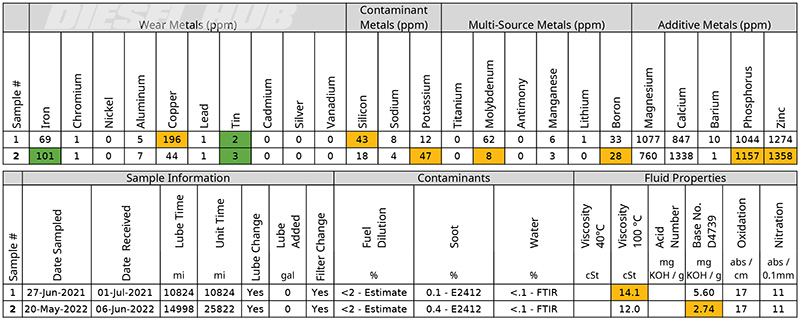
This vehicle is equipped with a standard output 6.7 liter Cummins Turbodiesel. My first remark is that iron concentrations (a wear metal) are significantly higher on the 2nd oil change than the first. Generally, wear metals are highest after the first oil change and are significantly lower in subsequent oil changes. Although the owner went an extra 4,000+ miles on the second interval, I would still expect this to be lower. If nothing else, it's worth monitoring.
You'll note that the reviewer flagged several of the additive levels. I keep an analysis from the unused product on file so that I can compare these values. Despite being flagged, there is nothing of concern to report here and the additive levels are on par for that product.
The base number of the oil was also flagged on the 2nd oil change. This is consistent with the higher soot content reported and the additional mileage driven. Although Cummins approves a 15,000 mile interval for this engine, I would pull back on the reigns a bit and test this oil around 12,000 miles to see if there is happy medium. I also know that this owner frequently tows with this truck and that a 15,000 mile oil change interval is excessive for how the vehicle is being used. Nonetheless, there is nothing alarming to report from this analysis.
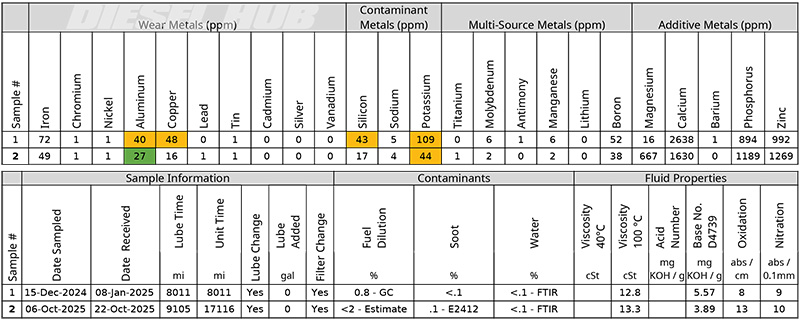
From figure 4, this 2023 Jeep Gladiator is powered by the 3.0 liter EcoDiesel engine. Immediately, you can see that iron and aluminum levels dropped significantly between the first and second oil change even though the latter was approximately 1,000 miles longer; this is indicative of a normal break-in period. Fuel dilution and soot concentrations are very low on this engine and the TBN has not been exhausted. This owner is following the guidance of the automated maintenance monitor and has no reason to change his routine at this point.
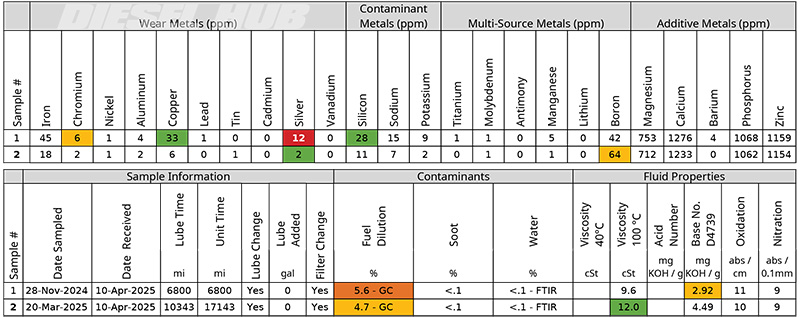
This 2023 Ford F-250 Super Duty is equipped with the optional high output 6.7 liter Power Stroke. From figure 5, you'll note that fuel dilution was flagged in both oil changes; 5.6% in 6,800 miles for the first oil change and 4.7% in 10,340 miles for the second oil change. The fact that the second oil change went an additional 3,500 miles without experiencing an increase in fuel dilution dampens any immediate concerns. Indeed, fuel dilution is on the high side but it is still under 5%. Fuel dilution is common with 6.7 liter Power Stroke engines because they use the post-injection method for bringing fuel into the exhaust system during regen.
Furthermore, wear metals were down on the 2nd oil change and nothing was flagged as a major concern. Despite the 4.7% fuel dilution, this engine is not experiencing excessive wear. I would advise this owner to perform the next oil change at 10,000 miles and monitor the trends. As of now, I find nothing alarming about this report.
Now let's look at a more concerning trend that I've been monitoring. The figure below shows an analysis chain that is tracking a significant fuel dilution issue.
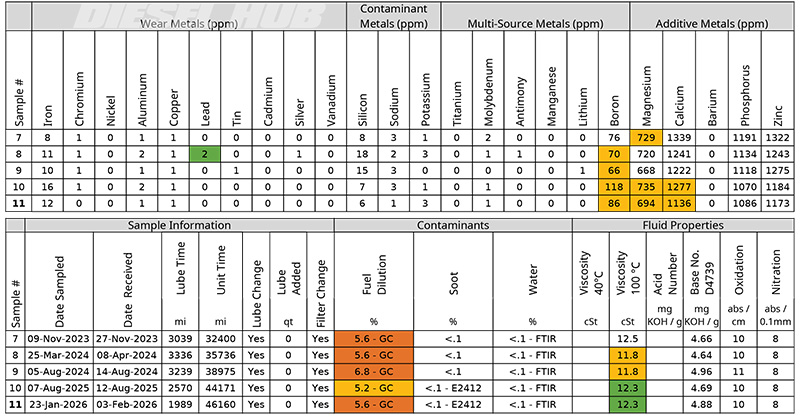
Note that fuel dilution is excessive, especially for such short intervals between oil changes (2,000 to 3,300 miles). The trend is getting worse because the mileage between intervals is getting smaller but the amount of fuel in the oil is not shrinking proportionately. Fortunately, this vehicle owner was monitoring the situation while attempting to identify the cause. Had they not been monitoring and repeatedly gone the full 10,000 miles between oil changes, this could have been disastrous.
Comparing Products
Analyzing a new, unused sample will give you a close look at the additive package present in a given motor oil. In fact, it's beneficial to have a baseline reference for the oil being used in a vehicle so that it can be compared to used samples as they are taken.
Additive depletion, viscosity, and TBN are more readily monitored when there is something to actually compare it to. If desired, the baseline data can also be used to compare the properties of different products. Table 1 below provides additive concentrations found in four prominent 5W-40 diesel oils.
| Sample | Mo | B | Mg | Ca | P | Zn | Viscosity | TBN |
|---|---|---|---|---|---|---|---|---|
| A | 1 | 200 | 91 | 2105 | 1030 | 1092 | 14.9 | 8.09 |
| B | 59 | 68 | 1184 | 812 | 1073 | 1168 | 14.6 | 8.79 |
| C | 1 | 101 | 7 | 2327 | 1143 | 1204 | 14.8 | 7.74 |
| D | 1 | 104 | 806 | 1340 | 1211 | 1324 | 14.6 | 9.71 |
[1] - Additive values given in part per million (PPM), viscosity provided in units of cSt at 212 °F, total base number (TBN) provided in units of mg KOH/gram
Mo - molybdenum (oxidation inhibitor, friction modifier)
B - boron (oxidation inhibitor)
Mg - magnesium (detergent)
Ca - calcium (detergent, dispersant)
P - phosphorus (detergent, anti-wear agent)
Zn - zinc (anti-wear agent)
First note the similarities - phosphorus and zinc levels are, for all intents and purposes, reasonably close. Samples B and D contain significantly lower levels of calcium than A and C, but higher levels of magnesium (both of which are detergents). Sample D stands out for its high TBN.
An engine oil producer can alter the additive package in their products at any given time. In fact, economics are a major factor in how these products are formulated. Consider a large displacement tractor engine where an only change requires 12 gallons, not 12 quarts. Price is a crucial consideration in the broader diesel engine oil market.
Frequently Asked Questions
Do I have to use oil that specifically formulated for a diesel engine?
Yes, a diesel engine requires an engine oil that is formulated for such applications. The additive packages in diesel oil formulations have a greater amount of detergents and dispersants to manage exhaust soot that leaks past piston rings and infiltrates the crankcase. Furthermore, diesel engines with exhaust aftertreatment require an engine oil that meets specific criteria to avoid catalyst poisoning and exhaust filter plugging (refer to API category above).
There are some less-common exceptions by which a motor oil meets all the requirements for both types of engines or their performance criteria overlap, but generally speaking a diesel engine requires a diesel motor oil.
Can I mix engine oils with different viscosity grades?
With limitations, yes, but there would be no reason nor benefit to do such a thing. If both oil viscosities are approved by the manufacturer for the engine and ambient temperature and both products meet all required criteria (API category, etc), they could be mixed. Such a situation would be due to circumstances, i.e. ran out of preferred viscosity and needed to top off engine oil.
Example - The manufacturer allows either a 5W-40 or a 10W-30 engine oil within the ambient temperature range the vehicle is being operated. The crankcase is full of 5W-40 and I noticed the level was low, but I only had 10W-30 oil on the shelf. I would not be in the wrong to top the engine off with 10W-30 as long as both products met any additional criteria required for this engine.
Can I mix conventional and synthetic motor oils?
Yes, but you would be missing out on the benefits of the synthetic oil. There are no inherent properties that make conventional and synthetic oil incompatible, they can be mixed.
Are synthetic blends a good balance between conventional and full synthetic engine oils?
In my opinion synthetic blends or semi-synthetic oils are marketing exploits. What are the ratios of conventional and synthetic base oils in the blend? Could be 50/50, could be 90/10. For maximum protection always use a full synthetic oil; if an engine requires a full synthetic oil do not substitute with a synthetic blend to save a few bucks.
Can I go longer between oil changes if I use a full synthetic engine oil?
My opinion is a resounding NO, but there's a bit of controversy here. Motor oil producers often market their full synthetic products with claims that oil change intervals can be extended. There are way too many variables that affect engine oil breakdown to make a universal claim that it is safe to extend oil change intervals.
Why do some engine oils labeled as a single and multi-grade oil?
I believe this practice is becoming less-common, but it has to do with motor oil producers capturing broader markets. An example that comes to mind is that diesel oil can sometimes be labeled as "SAE 30, 10W-30". SAE 30 used to be a common viscosity grade for tractors, agricultural equipment, and even some trucks. The manufacturer is specifying that if you have an engine that requires an SAE 30 diesel oil, their SAE 10W-30 oil meets this requirement. Multi-grade oils are by and large more common today.
What is special about engine oils made for "high mileage engines"?
Engine oils marketed for high mileage engines generally have a high TBN. The theory in play here is that there is more blow-by in a high mileage engine due to cylinder wall and piston ring wear, thus more combustion gases and byproducts are entering the crankcase and contaminating the oil.
The higher base number means the engine oil can neutralize of these contaminants before acids start to form (which would result in rapid break down of the oil). Some high mileage oils may also have a more prominent detergent package and you might note parallel claims that said products clean engine deposits and sludge. Side-note: if you change your oil regularly you need not worry about sludge in the engine.
Conclusion
The best oil for your engine is the one that is regularly changed at the manufacturer's recommended interval. In my experience, when the oil is changed is significantly more important that what oil is being used, assuming the oil in question meets any and all applicable requirements. On that note, the maintenance monitors that are integrated into modern vehicles are not nearly as intelligent as one might think. There is no magic sensor in the crankcase that is measuring the quality of the lube oil supply and these systems have no way of detecting fuel dilution rates.
I'm preferential to full synthetic lubricants because of their proven superiority, even when they're not required. Follow the data; audit your maintenance regiment by collecting and submitting an oil sample for testing. If the results determine that the oil condition is aligned with the maintenance monitor prediction, by all means continue this regiment. If the results determine that the oil condition is poorer than anticipated - high fuel dilution, excessive wear metals, low base number, for example - shorten the oil change interval accordingly and retest periodically to determine a more suitable routine.