
Applicable Models:
2003 - 2007 Ford F-250, F-350, F-450, F-550 Super Duty
2003 - 2005 Ford Excursion
2004 - 2010 Ford Econoline E-350, E-450
Applicable Engine(s):
6.0 liter Power Stroke V-8
Blue Spring Upgrade
All 6.0 liter Power Stroke engines utilize a simple spring-and-plunger type pressure regulator that is effectively a poppet valve. At the design pressure the poppet is lifted off its seat and excess fuel is returned to the tank. Replacing the fuel pressure spring on a 6.0 liter Power Stroke may often be referred to as the "Blue Spring Mod" or "Blue Spring Upgrade", a reference to the updated anodized blue pressure regulator spring that Ford introduced very shortly after the 6.0 liter launched.
The updated spring (serviced in kits 3C3Z-9T517-AG and 6E7Z-9C165-B) is significantly stiffer than the original, providing higher and more consistent fuel pressure. Although these kits are touted as an "upgrade", the updated spring was released during or for the 2004 production run. This means that the only engines that did not get the stiffer spring were produced in 2003. Despite these facts, retailers often advertise that the spring kit will raise fuel pressure. This is only true in the sense that the spring will be quite stiffer than that used on early engines while any pressure increases on 2004 and newer engines is simply because the current spring is worn out.
Ford's fuel pressure specification for the 6.0 liter requires that the system maintains a minimum 45 psi under all conditions. The system is roughly regulated to 55 psi, but it is common to measure between 55 and 65 psi at idle on a new spring. Low or inconsistent fuel pressure contributes to accelerated fuel injector wear and poor engine performance. For additional information on testing fuel pressure, see: Testing fuel pressure on a 6.0 Power Stroke.
Note that low fuel pressure does not immediately point to a collapsed pressure regulator spring or bad plunger seat; restrictions downstream of the secondary filter housing or a faulty fuel pump can also cause low pressure.
Required Parts
The fuel pressure spring and poppet valve are serviced in Ford kit 3C3Z-9T517-AG and 6E7Z-9C165-B. There's generally some confusion over the applicability of these two kits, so let me briefly explain the difference between the two.
Ford 3C3Z-9T517-AG is a re-branded International 1843065C98 and includes:
- Pressure regulator spring ("blue spring")
- Brass plunger and beveled seal
- Plunger sleeve and o-ring seal
- Bleed orifice bushing and o-ring seal
- Fuel return fitting o-ring seals (fitting to housing and face of fitting to line)
- Regulator housing cover and molded gasket
- Regulator housing cover cap screws (x4)
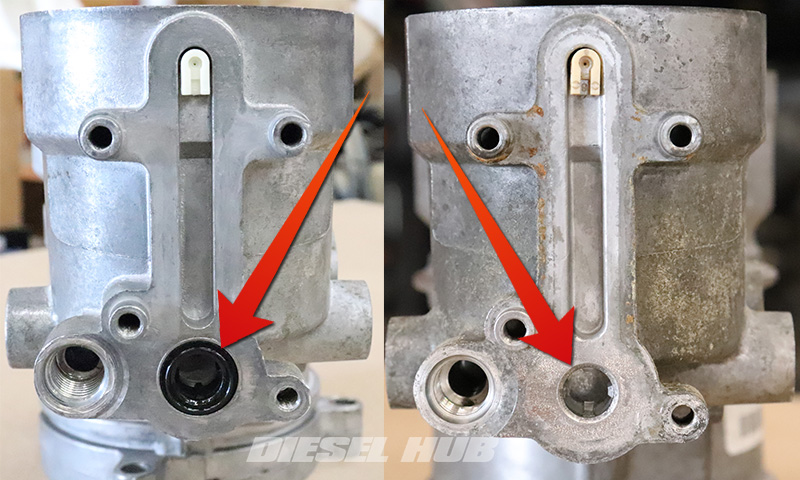
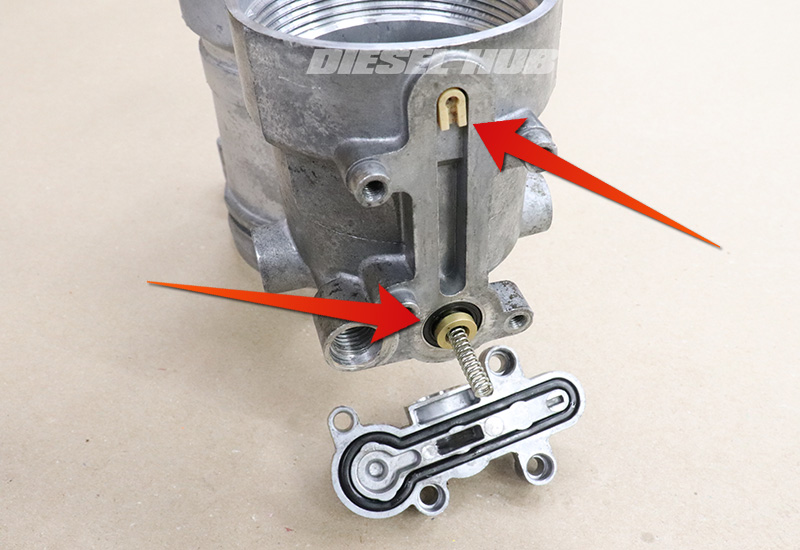
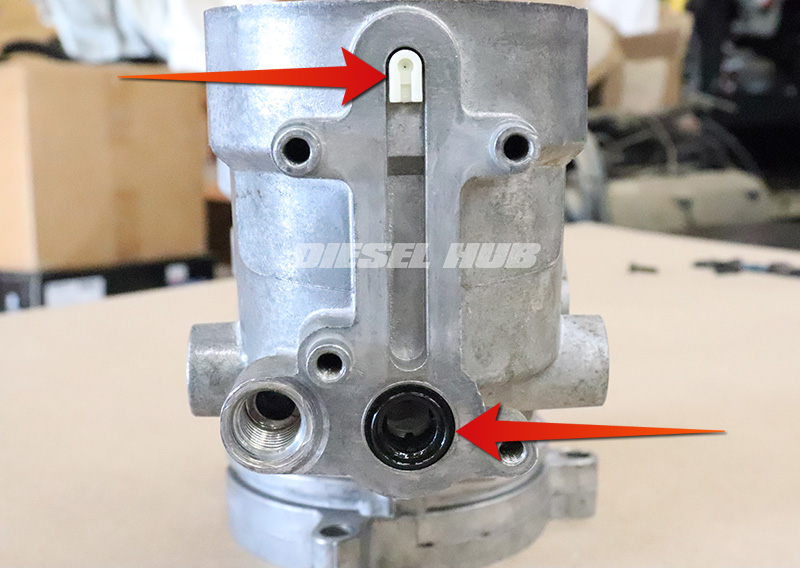
This is the original fuel pressure regulator service kit - it comes with a new spring, plunger, plunger sleeve, and seals for everything that is required to be removed during this repair. Although it includes a new regulator housing cover and hardware, these parts are generally reusable and thus not necessary. The poppet sleeve and its o-ring are only required for 2003 and 2004 model year engines. For 2005, this is machined into the filter housing and is no longer a serviceable component. Refer to figure 1 (below) for a visual of both filter housing types.
Ford 6E7Z-9C165-B is a re-branded International 1854267C94 and includes:
- Pressure regulator spring ("blue spring")
- Brass plunger and beveled seal
- Regulator housing cover molded gasket
- Filter housing cap o-ring seal
- Test plug o-ring seal
- Fuel inlet banjo bolt washers (x2)
- Outlet fitting o-ring seals (fittings to housing and face of fitting to outlet lines)
- Fuel return fitting o-ring seals (fitting to housing and face of fitting to line)
- Standpipe to filter housing o-ring seal (lower seal only)
- An extra o-ring that fits a VT-365 style filter housing but is irrelevant on a 6.0 liter Power Stroke engine
This is a combination pressure regulator service and filter housing rebuild kit; in addition to the spring and plunger, it includes most of the o-rings that are used to seal the filter housing. Notable missing is the plunger sleeve/o-ring, air bleed orifice/o-ring, and the inner/upper o-rings used on the standpipe.
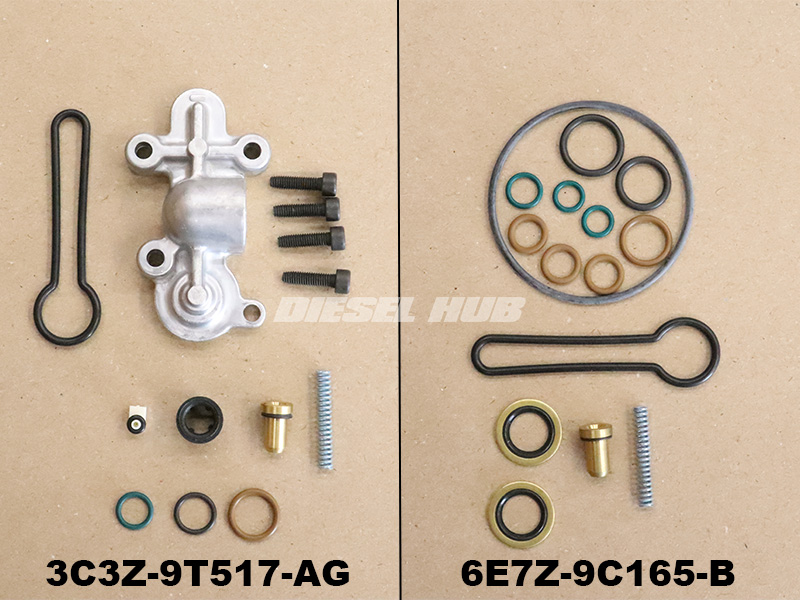
6E7Z-9C165-B can therefore be used on either model year, but it is missing the seal for the plunger sleeve. Furthermore, if this were to be used in its entirety on a 2003 or 2004 engine, it would be missing the pair of o-rings required to seal the fuel inlet fitting; there is no banjo bolt on the early engines and the fuel inlet fitting is identical to the return fitting.
In summary, using 3C3Z-9T517-AG on a 2005 and later engine would result in several unused parts from the kit. Using 6E7Z-9C165-B on a 2003 and 2004 engine would result in missing parts that are required to thoroughly complete the task, but if you reuse the poppet sleeve and o-ring this kit is priced significantly lower and it will work. Regardless of the engine year, if you use 6E7Z-9C165-B and you do not reseal the entire filter housing you will have many unused parts from the kit.
This is ultimately why 3C3Z-9T517-AG is often advertised as the 2003 and 2004 style kit, or the "with new cover" kit, and 6E7Z-9C165-B is often advertised as the 2005 to 2007 style kit, or the "without new cover" kit. For a van, use 6E7Z-9C165-B. The filter housings in the E-Series (2004 to 2010 model years) do not use the white air bleed orifice, nor do they have a removable plunger sleeve.
Both of these "Ford" kits are re-branded parts from International; Ford blacks out the International label and seals it in their own packaging.
Associated Parts
| Description | Part Number(s) | Remarks |
|---|---|---|
| Pressure regulator service kit | Ford 3C3Z-9T517-AG |
[1] |
| Filter housing service kit | Ford 6E7Z-9C165-B |
[1] |
| Economy kit | Alliant Power AP0086 | [2] |
| Fuel pressure test adapter | DP-161501 | [3] |
| Fuel filter set | Motorcraft FD-4616 | [4] |
[1] - See previous section detailing included contents and model year applicability
[2] - Economy kit; includes pressure regulator spring, cover gasket, and plunger seal only
[3] - Adds 1/4 inch flare test port to fuel filter housing
[4] - Fuel filter replacement recommended after regulator service
Pressure Regulator Replacement
The pressure regulator is incorporated into the secondary fuel filter housing, which is mounted on top of the engine. Removing the cold-side intercooler tube on the driver side creates ample space to reach the pressure regulator housing. You may note that I have the entire housing removed from the engine in subsequent images, but this is not required; the pressure regulator is easily serviced with the filter housing mounted to the engine, just remove the cold-side intercooler tube.
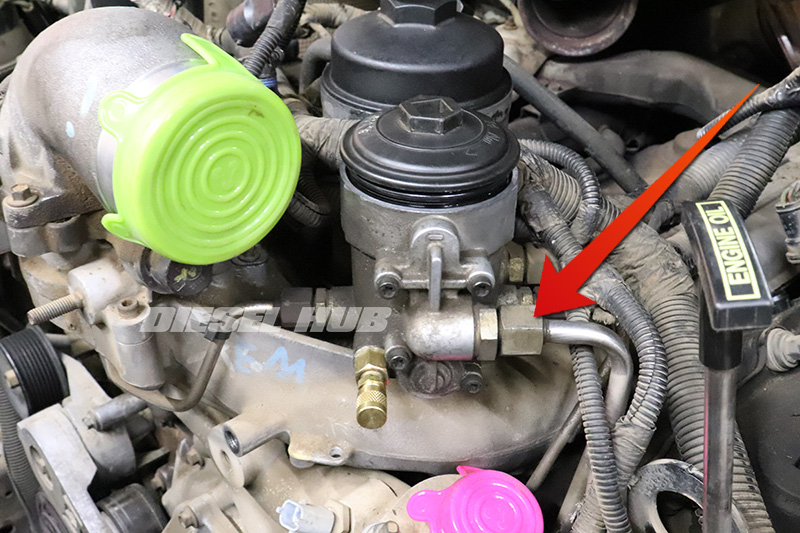
Before you can remove the pressure regulator cover, you will need to remove the tank return line fitting (arrow, figure 3). Place a bundle of shop rags beneath the connection, then hold the fitting threaded into the pressure regulator cover with a 22 mm wrench and loosen the large nut with a 13/16 wrench.
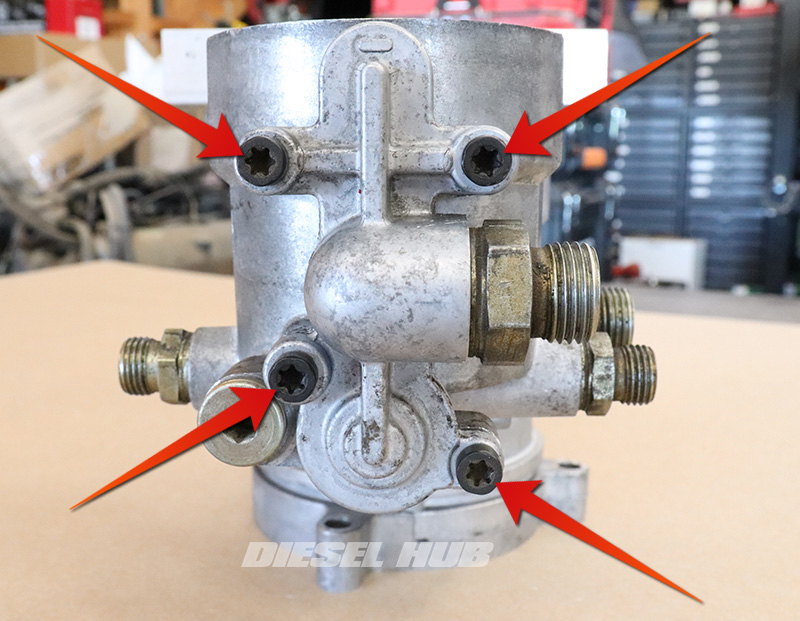
Next, hold the pressure regulator cover against the housing and remove the (4) retaining bolts with a T-27 Torx driver. Once each bolt has been removed, carefully release the housing and let the pressure regulator spring decompress. If this is done abruptly, the spring and plunger may become lost.
With the cover off, carefully remove the pressure regulator spring and plunger. If you're using kit 3C3Z-9T517-AG also remove the poppet sleeve (2003 and 2004 only) and the bleed orifice (all models except E-Series vans).
As applicable, remove and replace the o-rings on the plunger, sleeve, and bleed orifice. Note that the plunger uses a special beveled o-ring; the pointed side of the bevel must be inserted into the rim of the plunger. If you can see the beveled edge once it is installed, you've assembled it backwards. All o-rings should be coated in clean motor oil before they are installed.
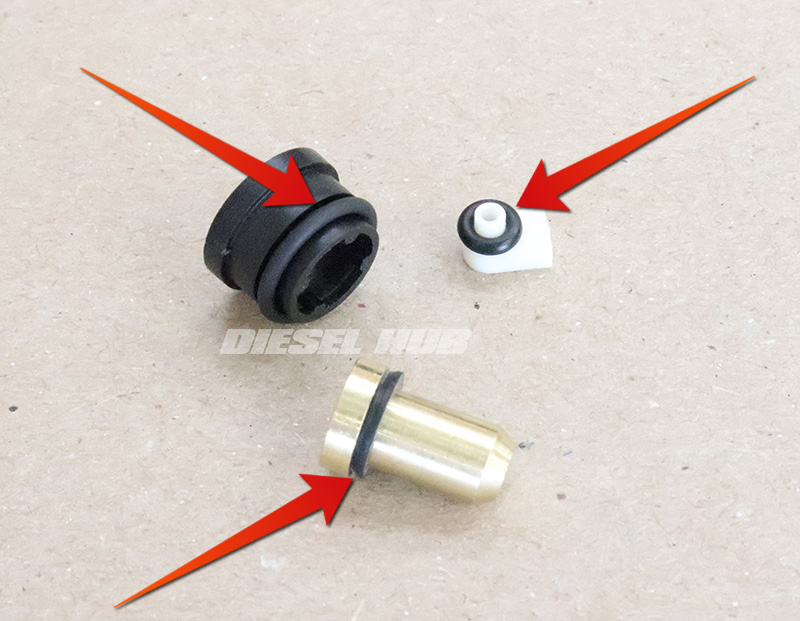
As applicable, reinstall the bleed orifice and poppet sleeve in reverse order. Note that they should both "snap" into place when the o-rings are properly seated.
Install the plunger and spring, noting that the narrow end of the plunger is inserted into the housing and the spring is inserted into the bore of the plunger. Next, coat the new cover gasket with clean motor oil and install it onto the pressure regulator housing cover.
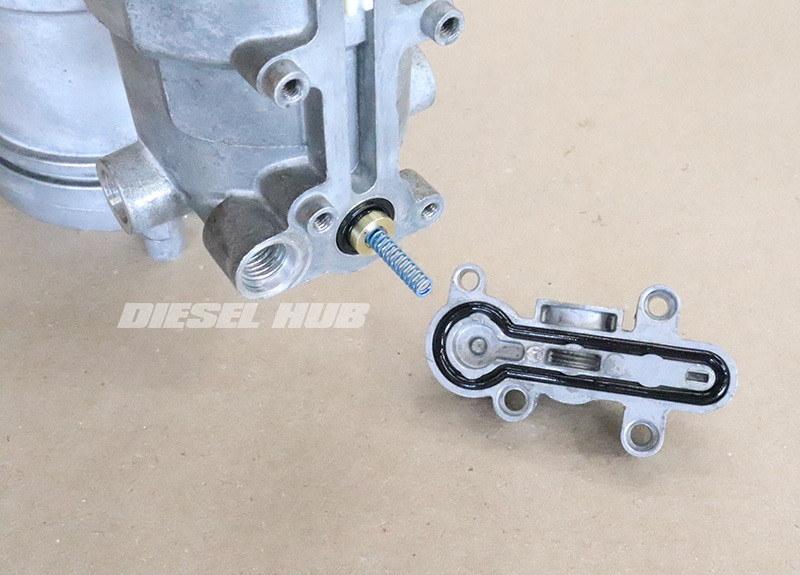
Install the pressure regulator housing, ensuring that the spring properly seats into the small indentation cast into the cover. If the spring becomes pinched against another part of the housing, fuel pressure will far exceed specification. While holding the cover tightly against the housing, install the (4) bolts and tighten snug. Do not use the bolts to compress the spring; hold it in place.
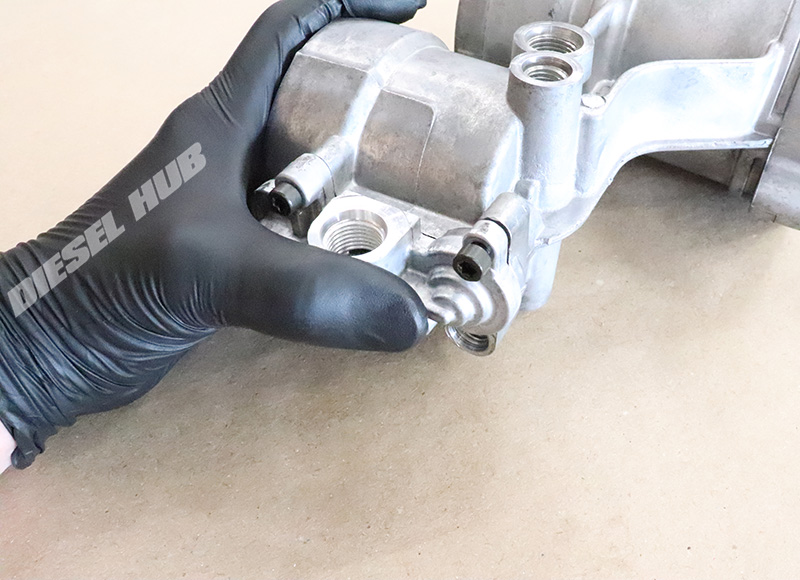
If the return line fitting has been removed and/or the cover replaced, make sure to install new o-rings on the fitting before reinstalling it. I highly recommend replacing the secondary fuel filter, followed by testing fuel pressure key on, engine off (KOEO) after bleeding air from the system. The easiest way to bleed air from the system is to turn the key to the "RUN" position to initiate the fuel pump. It will run for 15 to 20 seconds, then turn off. Repeat this approximately (10) times, or until you're confident that the fuel system has been properly primed.


Editor, Diesel Hub