The fuel pressure regulator on a 7.3 liter Power Stroke engine is incorporated into the fuel filter housing (fuel bowl). Early style filter housings are found on 1994 to 1997 model year engines that utilize a mechanical fuel pump. The later style housings are found on 1998 to 2003 engines that employ an electric fuel pump. There are significant differences between the filter housings on these two versions of the 7.3 Power Stroke and although none of the parts are interchangeable the action of the pressure regulator valve is similar in both cases.
An important distinction between the early engines with a mechanical fuel pump and the later engines with an electric pump is that the later is a dead end system. In 1994 to 1997 engines, fuel flows through a constant circuit in which it leaves the pump, enters the cylinder head, and returns to the fuel filter housing through the pressure regulator assembly. On later engines, fuel is pumped into the bowl and then is distributed to each cylinder head, but never returns to the filter housing. This is one of the reasons why the pressure regulator on later engines (electric fuel pump) is much simpler.
1994 to 1997 Engines
The fuel filter housing on early versions of the 7.3 Power Stroke is significantly more complex than that of the later style, but the pressure regulator mechanisms are quite simple. The pressure regulator housing mounts to the driver side of the housing. Fuel return lines from each cylinder connect to fittings at the front-most end of the housing. Behind these fittings and just above the fuel pressure test port is a brass cap (figure 1, below) - removing the brass cap with a 3/4 inch socket will expose the pressure regulator spring and spool valve.
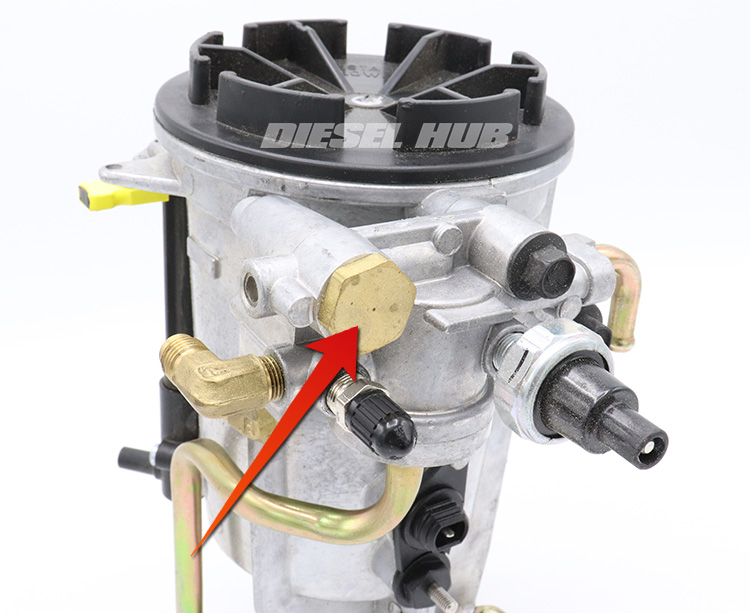
A collapsed fuel pressure regulator spring or a dirty/worn valve can both contribute to low fuel pressure. The OEM replacement part for engines with a Federal emissions package is F5TZ-9K061-A. Engines with a California emissions package use part F6TZ-9K061-AA. These include a new spool valve, spring, brass cap, and o-ring seal. Supplies of these parts are becoming limited as they are no longer manufactured and becoming obsolete.

When installing (or reinstalling) the valve and spring, note that there is a teat on the brass cap that must align with the spring to ensure proper alignment and pressure.
1998 to 2003 Engines
International significantly simplified the fuel system on the 7.3 liter Power Stroke beginning with the 1998 model update, which pre-dates the introduction of the 1999 Ford Super Duty; there was no 1998 model year F-Series, but certain E-Series vans still offered the engine in 1998. A major part of the simplification is that there is no return system for the cylinder head fuel galleries. Instead, pressure is regulated by exhausting excess pressure in the filter housing back to the tank. As a result, the fuel pressure regulator housing connects directly to the tank return line on the driver side of the housing (figure 3, below).

The tank return line fitting is removed with a 5/8 wrench, followed by the pair of machine screws that secure the pressure regulator cap to the housing with a T-27 Torx driver. The cap is under spring pressure, so be sure to hold it securely as both of these screws are removed. Beneath the cap you'll find the fuel pressure regulator spring and poppet valve.
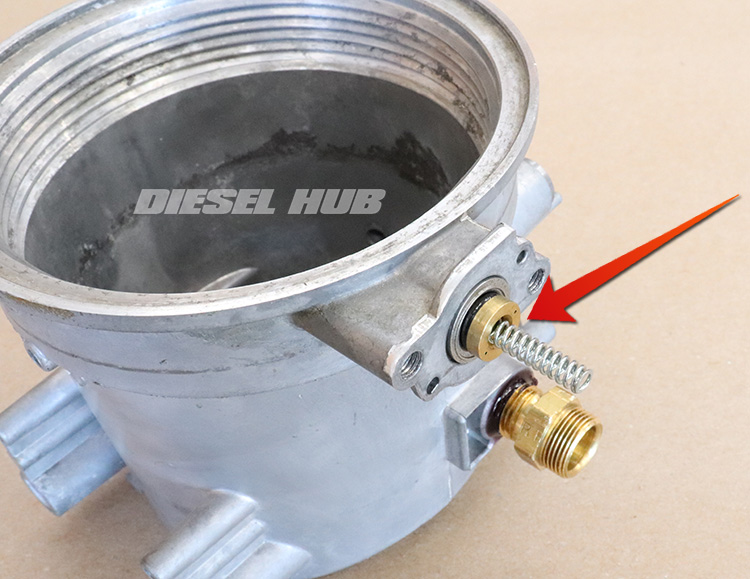
The poppet seals against a serviceable seat. The poppet valve is lifted off its seat when fuel pressure acting on the valve exceeds the opposing force enacted by the spring, returning fuel back to the tank. These components are all serviced in Ford kit F81Z-9B249-BB.

When the poppet and spring are installed, it is imperative that the spring aligns in the middle of the regulator housing/cap. If it catches on one of the outer ribs, fuel pressure may reach dangerously high levels before damaging one or more components in the fuel system. If the filter housing is removed from the engine for service, spring alignment can be verified by looking into the regulator cap through the threaded end. Additionally, note that the cap has two dowel pins cast into it that must align with holes in the filter housing.

If the poppet is being replaced, its seal does come installed. It must be installed with the bevel pointing into the wide part of the poppet or it will not seat correctly. This seal often gets installed incorrectly because its orientation is not necessarily intuitive unless you study the poppet valve.