The fuel lift pump, lift pump, or simply fuel pump on the 7.3 liter Power Stroke is responsible for supplying diesel fuel to each individual fuel injector via a network of channels integrated into the cylinder heads. These channels provide low pressure fuel to each injector through orifices found on the lower portion of the injector body. Fuel is drawn from the tank through the suction side of the pump and is pumped into the fuel filter housing where it is filtered and water is separated before it is distributed to each cylinder head channel.
1998 to 2003 model year engines utilize an electric fuel pump mounted to the frame rail between the engine and tank. This is overwhelmingly considered a more desirable system than the mechanical fuel pump found on earlier versions of the 7.3 liter Power Stroke. With the electric setup, fuel pressure is entirely independent of engine speed, fuel pressure is more consistent with less pulsation, and there is no chance of a fuel pump seal leaking and allowing raw fuel to infiltrate the crankcase.
The fuel pump is activated and will begin pressurizing the system when the key is turned to the "run" position, which also initiates the glow plug preheat cycle. If the engine is not cranked after approximately 15 seconds, the fuel pump will shut-off until the engine is cranked or started, at which time it will function continuously until the vehicle is shut-off. Operating the fuel pump during the "wait-to-start" period allows air to be purged from the system and fuel pressure to stabilize before the engine is cranked over. Additionally, this fuel system can be easily primed after service is performed without having to crank over the engine.
Symptoms of a Bad Fuel Pump
Low fuel pressure is an obvious sign of a struggling fuel pump and no fuel pressure would be indicative of a failed fuel pump, considering that it was confirmed to be receiving power. Fuel pump problems are common associated with hard start, no start, running rough, stalling and low performance conditions. Specifically with the rough running and stalling conditions, the vehicle may run normal at cruising speed but start to stumble under heavy load. Any of these symptoms should prompt the fuel pressure to be measured.
Ford's fuel pressure specification for the 7.3 liter Power Stroke is a minimum 30 psi, but this guidance is deceiving since pressure is regulated at a nominal 55 psi. For this reason, anything in the 50 to 65 psi range is more reasonably considered normal. Fuel pressure should be initially checked key on, engine off (KOEO) while the fuel pump is running during the wait-to-start period. If it is the 50 to 65 psi range, proceed to check fuel pressure at idle.
Low fuel pressure does not immediately indicate that a fuel pump is bad. The 1999 to 2003 fuel bowls have two test ports, one of which will measure the pressure of unfiltered fuel in the housing and the other will measure actual outlet pressure to the cylinder heads - if the difference between these pressures is large, suspect a clogged fuel filter that is restricting flow.

If the fuel pump is not running at all (zero pressure), verify that it is receiving battery voltage KOEO. If the pump is receiving power but not running, it obvious needs to be replaced. If no power is reaching the pump, locate the fuse/relay diagram in the owners manual and track down the source of this problem. These pumps make a distinct whirring noise, but any abnormal auditory cues or pressure readings could indicate problems with the sending unit in the tank. These include:
- Excessively loud fuel pump noise while running
- A bubbling noise resulting from air being introduced into the system on the suction side
- Fuel pressure is unstable, jumps up and down
- Pressure stabilizes or is improved and sound disappears when fuel tank is full, but returns when tank reaches roughly the 1/2 mark
The aforementioned symptoms point to a very common problem in the sending unit - the tank needs to be removed for further diagnosis. The filter screen in the tank could be clogged, the sending unit foot could have fallen off, or the tube that draws fuel from the tank could be compromised.
It is also possible that the fuel pressure regulator spring could be collapsing, which would result in lower than usual, but generally stable fuel pressure. When this happens, the spring in the pressure regulator starts letting the plunger off its seat at a pressure lower than 55 psi. The regulator spring generally does not need to be replaced often, but they do eventually lose there stiffness.
Fuel Pump & Related Parts
| Component | Part Number(s) | Remarks |
|---|---|---|
| Fuel pump assembly | Motorcraft PF1 | [1] |
| Fuel pump | Bosch 69136 | [2] |
| Fuel pump outlet fitting seal | M10 copper crush washer | [3] |
| Fuel pressure regulator rebuild kit | Ford F81Z-9B249-BB | [4] |
| Fuel pressure gauge adapter | Dieselply DP-160501 | [5] |
[1] - Includes wiring connector, clamp, bracket, insulator, etc; brand new bolt up assembly
[2] - Includes fuel pump only; pump is installed into existing bracket/clamp and uses existing wiring harness. Bosch is the OEM pump manufacturer.
[3] - Requires copper or aluminum crush washer matching these dimensions. These are generally accepted as one time use seals and should not be reused.
[4] - Only necessary if diagnostics reveal that the poppet valve, seat, and/or spring require replacement
[5] - Required to check fuel pressure on 1998 to 2003 model year engines
How to Replace the Fuel Pump on a 7.3 Power Stroke Diesel
Click any thumbnail to view fullsize, detailed image
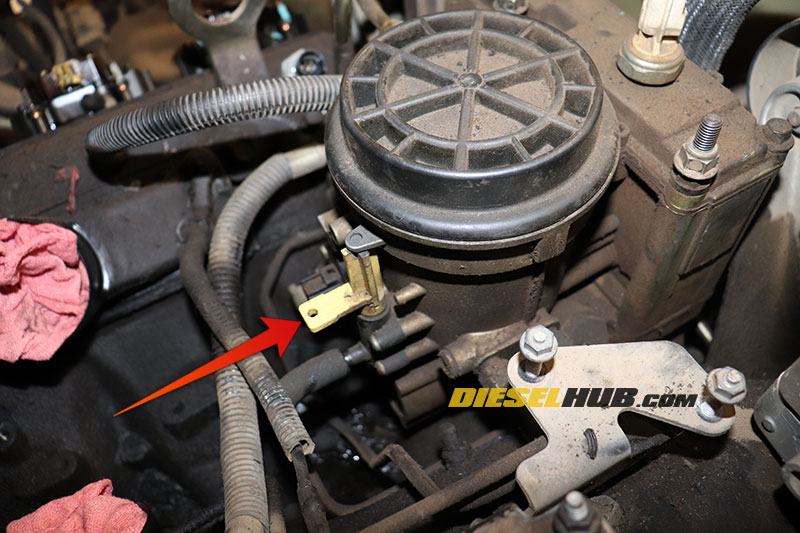
- Park the vehicle on a level surface and chock the wheels. Ensure that the vehicle is in park (automatic) or in gear (manual) and apply the parking brake.
- Disconnect both negative battery cables.
- Drain the fuel filter housing into an appropriate container. The yellow drain valve lever is located at the rear of the filter housing. The drain tube extends below the belt tensioner on the passenger side of the engine block.

- Locate the fuel pump mounted inside the driver side frame rail just below the driver's floorboard.
- If necessary, clean dirt and dust from the area directly around the fuel pump.
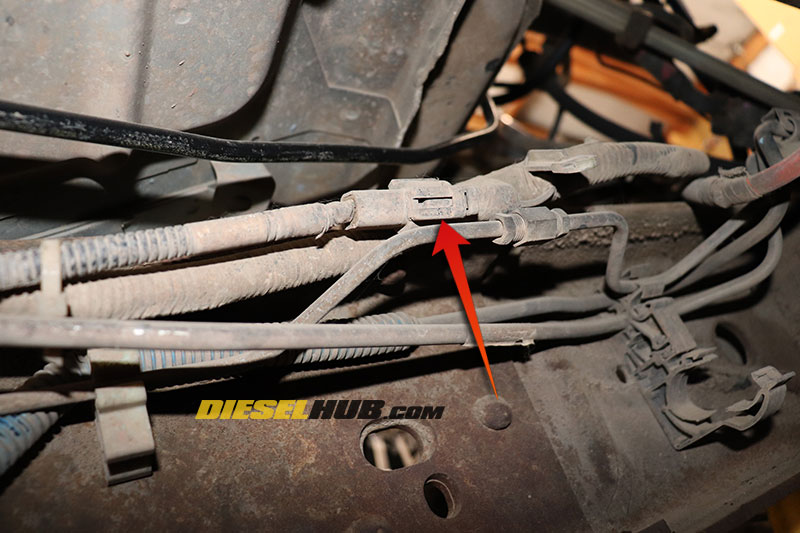
- Trace the wiring harness from the fuel pump towards the engine and locate the connector.
- Disconnect the fuel pump connector from the wiring harness by depressing the relief mechanism and separating the two connector shells.

- Place a suitable drain pan beneath the fuel pump to catch diesel fuel as the hoses are disconnected.
- Disconnect the fuel pump inlet hose (rear) by depressing the blue tab on the connection while pulling the hose fitting away from the pump. These connectors can be quite stubborn and some pressure is required to release the internal clip, particularly if debris has settled in the seat of the connector.
- Plug the inlet hose with a vacuum cap, fuel may siphon from the tank and won't stop until the level is significantly depleted.

- Maneuver the metal safety clip at the fuel pump outlet fitting (front) so that the tangs are positioned out of the fitting and a disconnect tool can be inserted.

- Orient a 3/8 inch fuel line disconnect tool into the outlet fitting (as pictured).
- Press the tool into the fitting while pushing the fitting into the tool.
- Once the internal spring clips are relieved, pull the hose fitting away from the fuel pump fitting to separate.
- It is important to push the tool and fitting into each other to relieve the spring clips.
- Allow the hose to drain completely, then plug the line.

- From the outside of the frame rail, remove the (3) nuts from the fuel pump mounting studs with a 13 mm socket or wrench.
- Remove the fuel pump and bracket from the frame rail.

- If a new Ford pump assembly is being installed (pump, bracket, harness), install the new assembly in reverse order; no additional steps necessary.
- Disconnect the electrical terminals from the wiring harness.
- Set the wiring harness aside to be installed on the new pump.
- Loosen the bracket clamp with a 7 mm socket, then slide the fuel pump out.
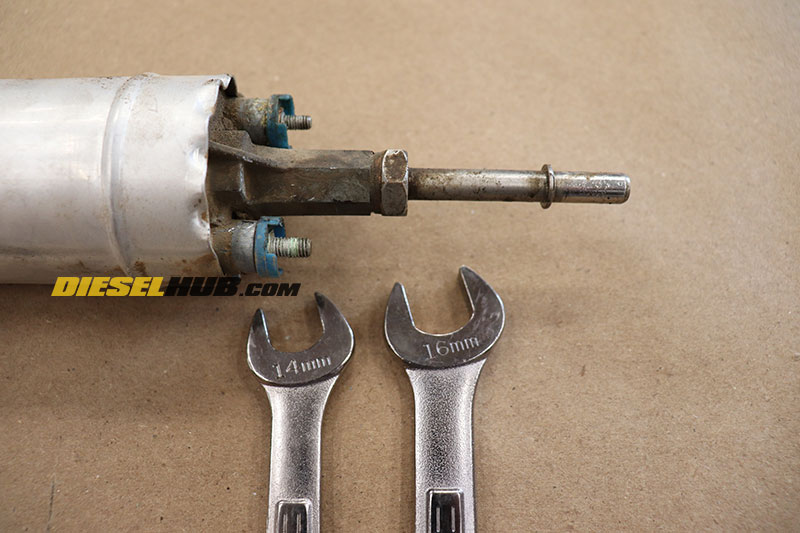
- Remove the outlet fitting from the old fuel pump.
- Hold the body of the fuel pump with a 14 mm wrench and loosen the fitting with a 16 mm wrench.

- Remove the copper crush washer from the fuel pump outlet fitting (if applicable).
- Thoroughly clean the fuel pump outlet fitting.
- Clean the bracket and isolation pad as necessary.

- Install a new crush washer on the fuel pump outlet fitting, then thread it into the new fuel pump.
- Cinch the fitting down enough to seat the crush washer, but do not overtighten.
- Place a vacuum cap over the fitting to prevent debris infiltration.

- Install the wiring harness, noting the "+" and "-" labels.
- Install the fuel pump into the mounting bracket.

- Secure the fuel pump to the frame rail.
- Reconnect the wiring harness.
- Secure the fuel pump inlet and outlet fittings. Note that a section of flexible medium pressure hose can be used on the suction side of the pump if the fitting is damaged. Using flexible hose on the outlet is not advised as hose clamps will not secure the line sufficiently due to the relatively high pressure.